Choosing Your First Boat: A Practical Buying Guide for 2025
A 12-question framework for picking the right first boat: bowrider vs center console vs pontoon, new vs used, financing, surveys, and hidden costs.
The 12 Questions
Before you visit a dealership or browse BoatTrader, answer these honestly. Write the answers down. The boat that fits your answers is the boat you should buy.
1. What will you do with the boat 80% of the time?
Not what you dream of doing — what you'll realistically do. If 80% of your trips will be sunset cruises with drinks and friends, a bowrider is right. If 80% will be fishing, you want a center console or a walleye boat. If 80% will be watersports, you need an inboard tow boat.
The mistake is buying for the 20%: the one offshore trip you'll take a year, the one trip to the sandbar with 12 people. Buy for the 80%.
2. Where will you keep it?
Storage is the most overlooked cost in boat ownership. Your options:
| Storage type | Monthly cost | Notes |
|---|---|---|
| Trailer in your driveway | $0 | Check HOA/city rules first. |
| Marinal wet slip | $200-800/ft | Hull grows marine growth; bottom paint needed ($1,500/yr). |
| Dry stack storage | $300-600/month | Best for boats 18-30 ft; marina launches for you. |
| Indoor storage | $10-15/ft/month | Off-season only; protects from weather. |
If you don't have a trailer-friendly driveway and dry-stack is unavailable in your area, a wet slip doubles your annual cost. Budget accordingly.
3. How many people, normally?
A 17-foot boat is comfortable for 2-3 adults. A 19-footer fits 4. A 21-footer fits 5-6. Beyond 6 people, you want a pontoon or a deck boat. Never believe the boat's "person capacity" plate — that's a safety maximum, not a comfort maximum.
4. Freshwater or saltwater?
Saltwater demands:
- Closed-loop cooling on the engine (or full freshwater flush after every use)
- Stainless or bronze hardware (not galvanized)
- Bottom paint if kept in the water
- A more robust electrical system (corrosion) — our marine electrical systems guide covers the basics
A freshwater-only boat moved to saltwater will work, but plan $3,000-5,000 in conversion costs over the first two years.
5. Tow vehicle capacity?
If you're trailering, your tow vehicle matters more than the boat. A 19-foot bowrider with a 4.3L V6 stern drive weighs ~3,800 lb on the trailer. A midsize SUV (Explorer, Tahoe, 4Runner) handles that. A 22-foot center console with twin outboards and a heavy trailer can hit 6,500 lb — you need a full-size truck or SUV.
Check your vehicle's tow rating and subtract 1,000 lb for safety margin. That's your max boat+trailer weight.
6. What's your real budget?
A $30,000 boat does not cost $30,000. Annual cost of ownership typically runs 10-15% of the boat's value:
7. New or used?
For a first boat, buy used. Here's why:
- New boats depreciate 25-30% in the first three years. Used boats have already taken that hit.
- A 5-year-old boat from a quality brand (Boston Whaler, Edgewater, Robalo, Sea Ray) is functionally identical to a new one and costs half as much.
- The first owner worked out the warranty bugs.
- You'll make mistakes with your first boat. Better to ding a $20,000 hull than a $45,000 one.
The exception: if you'll keep the boat 10+ years, the depreciation math flips and new becomes reasonable.
8. Outboard, stern drive, or inboard?
| Drive type | Best for | Maintenance | Lifespan |
|---|---|---|---|
| Outboard | Fishing, saltwater, shallow water | Easy (tilt up, flush) | 1,500-2,500 hrs |
| Sterndrive (I/O) | Bowriders, wake boats, lakes | Moderate (bellows, gimbal bearing) | 1,000-1,800 hrs |
| Inboard (direct/v-drive) | Wake/ski boats, large cruisers | Low (auto-style engine) | 2,000-3,500 hrs |
For saltwater, outboard is the right answer. For freshwater wake sports, inboard. For mixed freshwater use, stern drive is acceptable but plan $1,000/yr in bellows/u-joint maintenance. The differences trace back to hull design — match the drive to the hull's intended use.
9. Should you get a survey?
Always, on any used boat over $10,000. A marine survey costs $400-800 and is the cheapest insurance you'll ever buy. Look for a surveyor certified by SAMS or NAMS. The surveyor will:
- Tap-test the hull for delamination
- Check the engine compression (if possible)
- Inspect the trailer frame and axle
- Identify moisture in the transom or stringers
- Verify the title/HIN matches the boat
A survey that finds $5,000 of problems you didn't know about has paid for itself 10x.
10. What's the resale market?
Some boats hold value; some don't. As a rule:
- Boston Whaler, Grady-White, Robalo, Edgewater hold value exceptionally well.
- Sea Ray, Four Winns, Chaparral hold value reasonably well.
- Bayliner, Hurricane, low-end pontoons depreciate fast.
- Tige, Malibu, MasterCraft (wake boats) hold value well if low hours.
Before you buy, search BoatTrader for 3-5 year old examples of the same model. That's your realistic resale value.
11. Will your spouse/family actually use it?
This is the question nobody asks and everybody should. The #1 reason boats get sold within 3 years isn't mechanical failure — it's that the family doesn't use it. Before buying, take your partner and kids on a charter or rental of the same type of boat. If they don't love it, don't buy it.
12. Have you chartered or rented this type of boat?
If the answer is no, rent first. A weekend rental costs $500-1,500. It's the cheapest way to find out whether you actually enjoy center console fishing, pontoon sandbar trips, or watersports towing — before you commit $30,000+.
The Recommended Starter Boats (2025)
If you've answered the 12 questions and still want a recommendation, here's our short list by use case:
| Use case | Boat | Price (used, rigged) |
|---|---|---|
| Family day cruising (freshwater) | Sea Ray SPX 190 (2018+) | $28,000-34,000 |
| Family day cruising (saltwater) | Boston Whaler 170 Montauk (2018+) | $32,000-40,000 |
| Inshore fishing | Robalo R160 (2019+) | $26,000-32,000 |
| Sandbar / party boat | Sun Tracker Party Barge 22 (2020+) | $28,000-36,000 |
| Wake sports | Tige ZX1 (2018+) | $80,000-110,000 |
| Multi-day coastal cruising | Cutwater C-24 (2017+) | $80,000-110,000 |
What to Skip on Your First Boat
Dealerships will try to upsell you on a long list of "must-have" options. For a first boat, skip:
- Stereo upgrades. The base stereo is fine.
- Bow cushions. Nice, but $400 you can spend elsewhere.
- Generator. If you need a generator, you're not buying your first boat.
- Cockpit tables. You'll use them twice.
- Upgraded wheels on the trailer. They don't matter.
Spend the money on: a good VHF radio, an EPIRB or PLB, life jackets that fit, and a boating safety course. The USCG boating safety site lists state-specific course requirements and approved providers.
Closing Thoughts
The right first boat is the one that matches your honest answer to "what will I do 80% of the time?" — not the boat that matches your fantasy. The boat-buying industry is built on selling fantasies. Your job is to resist.
Buy used. Get a survey. Match the boat to your real use case. And then — this is the most important part — use the boat. Boats that sit unused deteriorate faster than boats that are run weekly. The cheapest boat to own is the one you actually take out.
Need a personalized recommendation? Contact us with your budget, use case, and location, and we'll point you toward the right hull. Try our boat finder or boat comparison tool to narrow your short list, or read our trailer maintenance guide and winterization checklist to plan the full cost of ownership.
Keep reading
Related articles
 Guides6m
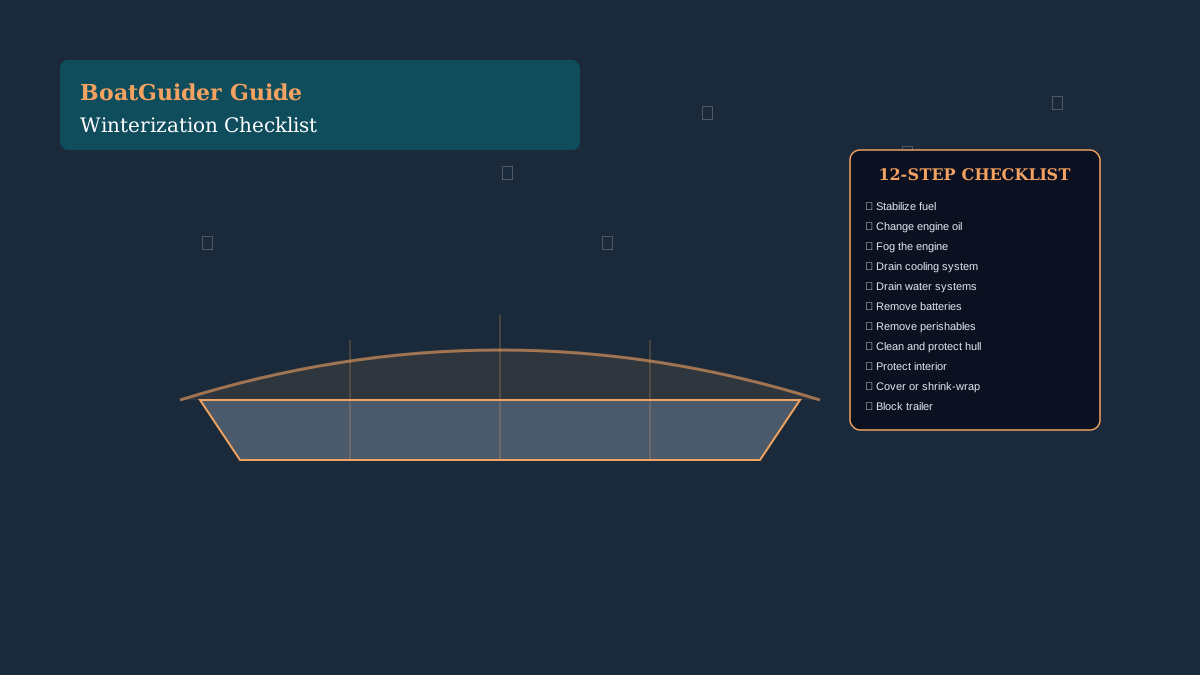
Winterizing Your Boat: The Complete Off-Season Checklist
Proper winterization prevents $5,000+ in freeze damage. Learn the 12-step process from engine fogging to antifreeze that keeps your boat safe all winter.
 Guides7m
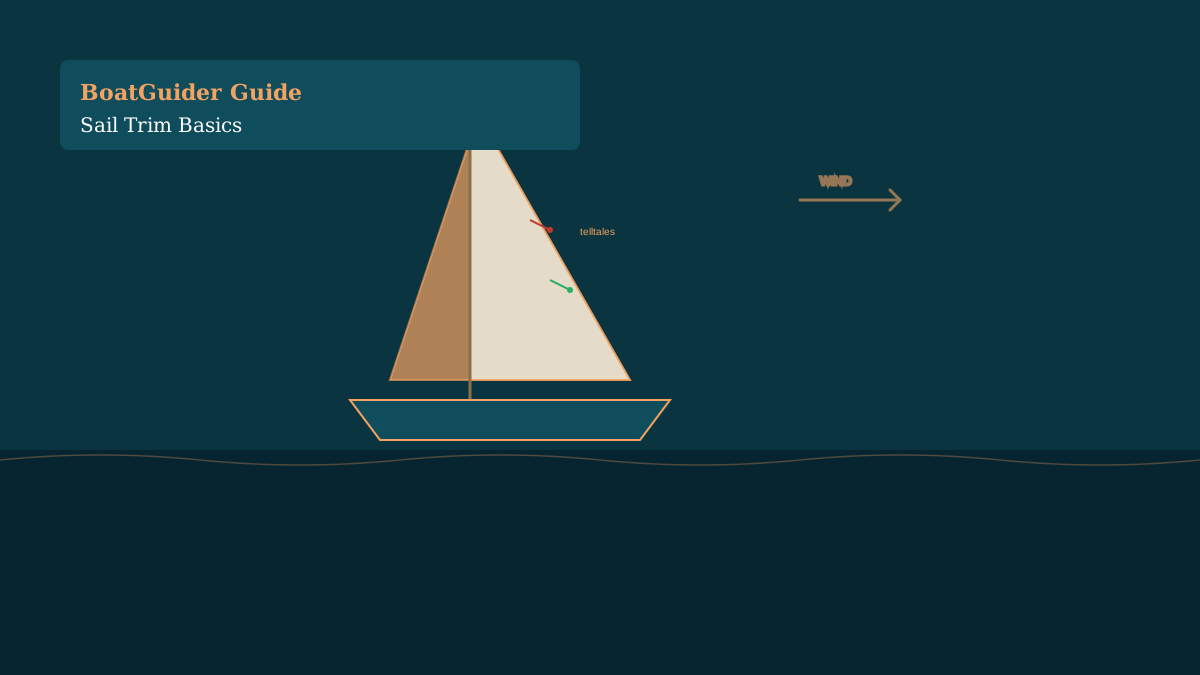
Sail Trim Basics: More Speed and Balance
Sail trim is the art of adjusting sails for the wind. Learn to read telltales, understand the slot effect, and trim for pointing vs reaching in this guide.
 Guides7m
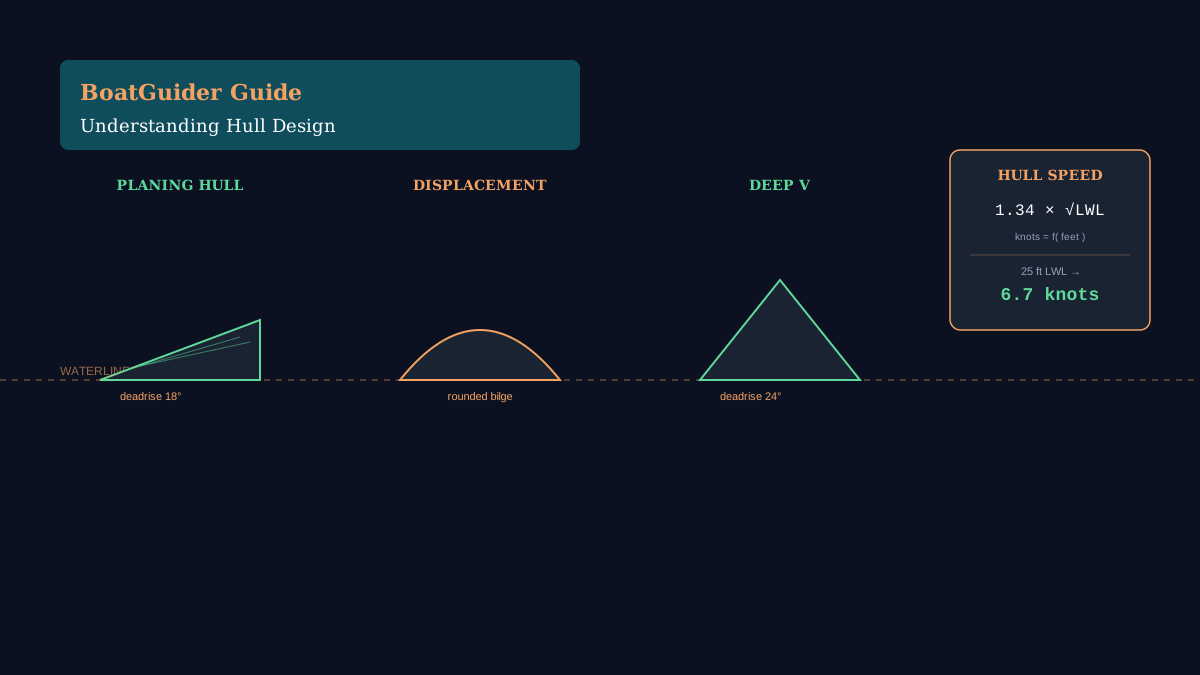
Understanding Boat Hull Design: A Naval Architect's Guide
Planing vs displacement, deadrise angles, chine shapes. Learn how hull design affects ride quality, speed, and fuel efficiency from a naval architect.