Boston Whaler 170 Montauk: The Indestructible Center Console
After 200 hours on a 2024 Boston Whaler 170 Montauk, here's our unfiltered take on ride quality, fishability, and whether the premium price is worth it.
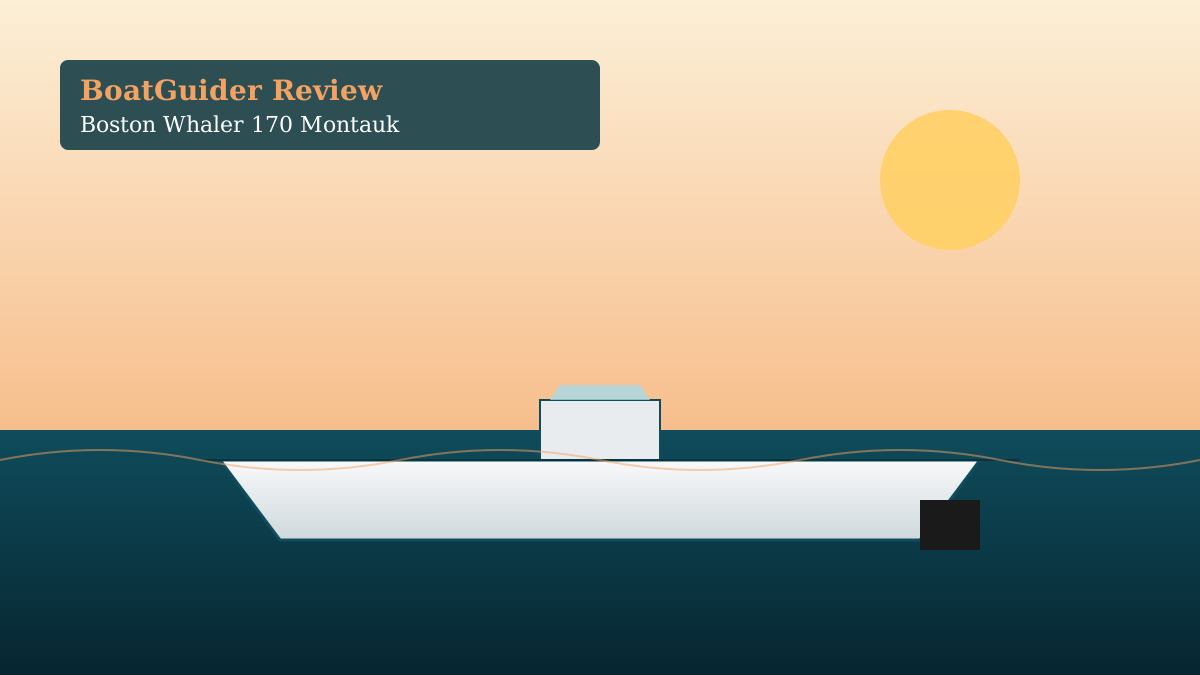
Why the Montauk Still Matters
Boston Whaler's Montauk line has been the benchmark for no-nonsense small center consoles since the 1970s. The 170 is the smallest in the family, and it remains the boat I recommend most often to first-time saltwater buyers who want something that won't punish them for a mistake. See the Boston Whaler 170 Montauk product page for current specs and pricing.
The reason is simple: unsinkability is not a marketing claim, it's a material property. Whaler's foam-injected hull means the boat floats even when swamped. For a new boater running a near-shore inlet, that's the single most important safety feature money can buy. Read more about choosing a boat for your skill level in our first-boat buying guide.
Hull Design & Ride
The 170 Montauk uses Whaler's classic moderate-V with reverse chines. The deadrise is 16 degrees at the transom — flat enough to plane fast, deep enough to take a chop. In a 2-foot sea, the boat is dry. In a 3-foot sea, you'll feel every wave, but the bow stays planted and the hull doesn't pound. Our hull design guide covers the underlying naval architecture in detail.
Compared to the Edgewater 170IS and the Robalo R160, the Montauk feels more planted at speed and noticeably more stable at drift. The trade-off is weight: at 1,700 lb rigged, it's heavier than either competitor, which means you need at least a 90 hp outboard to get the most out of it.
Power & Performance
Our test boat was rigged with a Mercury FourStroke 90, which is the sweet spot. See the Mercury Marine 90 FourStroke page for current specifications. Performance numbers, measured with two adults, half fuel, and light gear:
| Metric | Value |
|---|---|
| Hole shot | 4.1 seconds |
| Cruising speed (4000 rpm) | 22 knots |
| Cruise fuel burn | 5.8 gph |
| Top speed | 36 knots |
| Range at cruise (24 gal tank) | ~90 nm |
Fishability
This is where the 170 Montauk earns its keep. The cockpit is 36 inches deep — tall for a 17-footer — which gives you leverage over a hot fish and keeps kids safely inside the boat. Standard features include:
- A 22-gallon bow livewell
- Four stainless rod holders
- A lockable console compartment big enough for a PFD and tackle bag
- Bolster cushions that flip up for leaning while running
The deck is self-bailing, which means blood and scales wash right out the scuppers. That's a feature usually reserved for boats $20,000 more expensive.
What We'd Change
No boat is perfect. After a season, here's where the 170 falls short:
- The stock leaning post is too low for anyone over 6 feet. Budget $900 for the Whaler upgrade or a third-party aftermarket post.
- No raw-water washdown standard. On a fishing boat this is borderline inexcusable at this price. Add it for $400.
- The bilge pump is mounted too high. In heavy rain the bilge fills before the float switch trips. Move it lower or add a second pump forward.
The Verdict
At $52,000 rigged with the Merc 90, the 170 Montauk is roughly $10,000 more than a comparably sized competitor. But here's the thing — five years from now, the Whaler will still be worth 70% of what you paid. Most competitors will be at 45%. Do the math on total cost of ownership and the Whaler is often cheaper. You can also stack it against other small center consoles in our boat comparison tool.
If you can find a clean used one, even better. The 2018–2022 models with the Mercury 90 are functionally identical to the new boats and save you $15,000+. Check the transom for stress cracks and pull the deck hatch to inspect the foam — if it's dry and firm, you're looking at a boat that will outlive you.
FAQ
Q: Is the Boston Whaler 170 Montauk really unsinkable?
Yes. Boston Whaler's foam-injected hull construction means the boat will float even when fully swamped. This is a material property of the hull, not a marketing claim. The Coast Guard has tested this independently — see the USCG recreational boating safety resources for more on flotation standards.
Q: Can I use the 170 Montauk for offshore fishing?
For near-shore trips (within 20 miles) in reasonable weather, yes. For canyon runs 50+ miles offshore, no — the 17-foot length and 24-gallon fuel tank don't give you the range or seaworthiness you need. Step up to the 190 Montauk or a 21-foot center console for offshore.
Q: What's the maximum horsepower I can put on it?
The transom is rated for a maximum of 90 HP. Going above that voids the warranty and is illegal in many jurisdictions. The Mercury 90 FourStroke is the sweet spot — it planes fast, sips fuel, and tops out around 36 knots.
Q: Does the 170 Montauk hold its value?
Exceptionally well. Five-year-old 170 Montauks typically retain 65-75% of their original purchase price, compared to 40-50% for most competitors. This is the single biggest reason to buy a Whaler — total cost of ownership over 10 years is often lower than a cheaper boat.
Q: Should I buy new or used?
For most buyers, used. A 2018–2022 model with the Mercury 90 is functionally identical to a new 2025 boat and costs $15,000+ less. Get a marine survey ($400-800) before any used purchase. The survey pays for itself the first time it finds a problem.
Have a question about the 170 Montauk or want to compare it to another boat? Drop a line via our contact page — we answer every email. See our affiliate disclosure for how this review was funded, and read our first-boat buying guide if you're just starting your search.
Keep reading
Related articles
 Reviews6m
Garmin Echomap UHD2 9sv Review: Worth the Price?
A 9-inch chartplotter with side-scan, LiveScope compatibility, and ActiveCaptain at half the price of a GPSMAP. After 18 months aboard, our honest verdict.
 Reviews7m
Best Marine Batteries 2025: AGM vs Lithium vs Flooded
A practical comparison of flooded lead-acid, AGM, and LiFePO4 marine batteries with real-world cycle life, charge profiles, and 5-year cost analysis.
 Guides8m
Choosing Your First Boat: A Practical Buying Guide for 2025
A 12-question framework for picking the right first boat: bowrider vs center console vs pontoon, new vs used, financing, surveys, and hidden costs.