Understanding Boat Hull Design: A Naval Architect's Guide
Planing vs displacement, deadrise angles, chine shapes. Learn how hull design affects ride quality, speed, and fuel efficiency from a naval architect.
The Two Fundamental Hull Types
Every boat hull falls into one of two categories: displacement or planing. The difference is whether the boat pushes water aside or rides on top of it.
Displacement Hulls
Displacement hulls — sailboats, trawlers, tugs — push water aside as they move. Their speed is limited by the wave they create: go faster than the wave's speed and the boat tries to climb its own bow wave, requiring enormous power.
The theoretical limit is hull speed, calculated as:
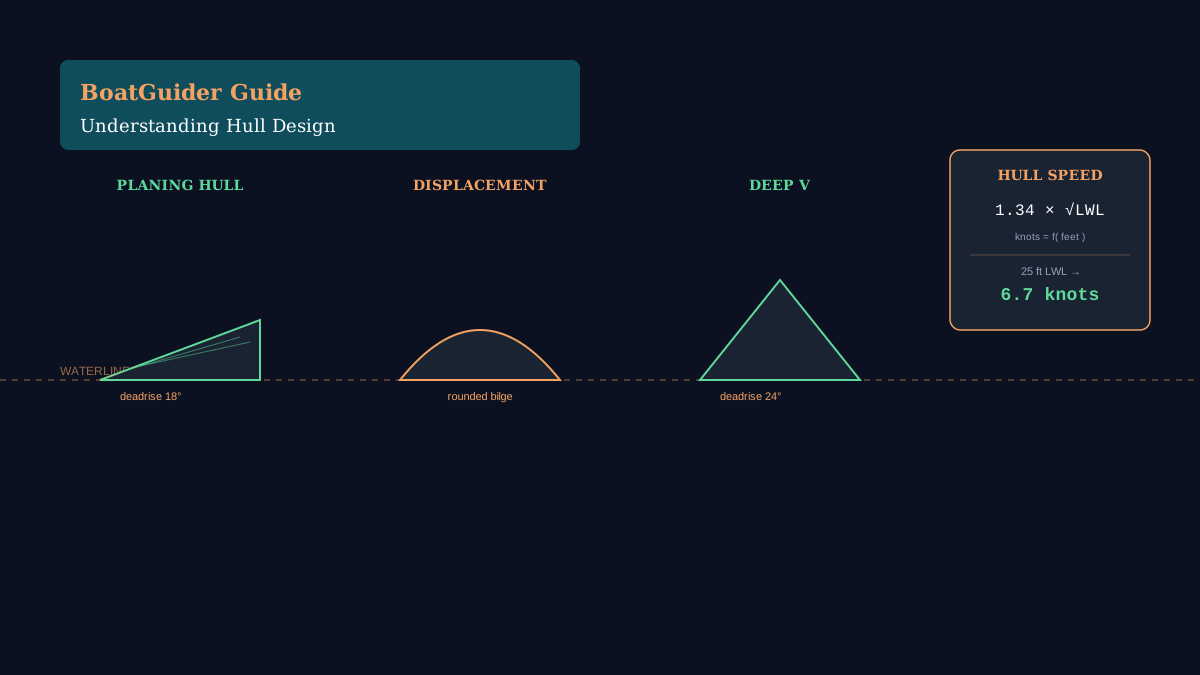
Hull Speed (knots) = 1.34 × √LWL
where LWL is length at the waterline in feet. A 25-foot waterline boat has a hull speed of ~6.7 knots. To go faster requires exponential power — most displacement boats cruise at 80-90% of hull speed for efficiency.
Planing Hulls
Planing hulls — center consoles, bowriders, runabouts — are designed to climb on top of the water at speed. Once "on plane," the hull is supported by hydrodynamic lift rather than buoyancy, dramatically reducing drag and enabling much higher speeds. For a deeper technical dive, see the Wikipedia article on planing watercraft.
The transition from displacement to planing is called "getting on plane" and typically happens at 12-18 knots for most recreational boats. Below that speed, the boat is in "displacement mode" and handles differently (more squat, more wake, less responsive steering).
Deadrise: The Most Important Number
If you learn one hull-design term, make it deadrise. Deadrise is the angle between the hull bottom and the horizontal, measured at the transom. It's the single biggest factor in how a boat rides. See Wikipedia's article on hull shapes for diagrams of the angles.
- 0-8 degrees (flat): Fast planing, shallow draft, but pounds in chop. Skiffs, jon boats.
- 12-18 degrees (moderate V): Good balance — planes easily, reasonable ride. Most bowriders.
- 18-24 degrees (deep V): Smooth ride in rough water, but harder to plane and less stable at rest. Offshore center consoles.
- 24+ degrees (very deep V): Excellent rough-water ride, but needs more power to plane and rolls at rest. High-performance offshore.
Here's how deadrise ranges translate to ride quality, planing efficiency, and typical use:
| Deadrise Range | Ride Quality | Planing Efficiency | Typical Use |
|---|---|---|---|
| 0-8° (flat) | Pounds hard in chop | Excellent — planes fast, shallow draft | Skiffs, jon boats, inland waters |
| 12-18° (moderate V) | Reasonable in moderate chop | Good — planes easily, efficient cruise | Bowriders, small runabouts, lakes |
| 18-24° (deep V) | Smooth in rough water | Moderate — needs more power to plane | Offshore center consoles, coastal |
| 24°+ (very deep V) | Excellent in heavy seas | Lower — needs significant horsepower | High-performance offshore, canyon runners |
Chine Shapes: How the Hull Meets the Water
The chine is where the hull bottom meets the sides. Its shape affects how water separates from the hull, which affects lift, spray, and stability.
Hard Chine
A sharp angle between bottom and side. Hard chines create a clean water separation, which helps a planing hull lift. They also make the boat more stable at rest (the chine acts like a small outrigger). Common on aluminum boats, skiffs, and some performance hulls.
Soft Chine
A rounded transition. Soft chines are quieter and smoother in displacement mode but provide less lift and less stability at rest. Common on sailboats and trawlers.
Reverse Chine
The chine curves upward at the edge, trapping air and water under the hull. This creates extra lift and deflects spray downward (drier ride). Common on Boston Whaler, Edgewater, and similar premium hulls — see our Boston Whaler 170 Montauk review for a real-world example. The tradeoff is more drag at low speeds.
The Running Surface: Strakes and Pads
Look at the bottom of a planing hull and you'll see longitudinal ridges — these are strakes (or lifting strakes). They serve two purposes:
- Lift: Strakes create additional planing surface, helping the boat get on plane faster
- Spray deflection: The outer strakes knock down spray, keeping the deck dry
A pad is a flat section on the hull bottom (often at the keel) that provides a stable planing surface. Pads increase top speed (less wetted surface at full plane) but can make the boat sensitive to trim.
Entry: How the Bow Meets the Water
The entry is the shape of the bow at the waterline. A sharp entry cuts through waves smoothly; a blunt entry pounds. The entry angle is the angle between the keel and the waterline at the bow.
- Sharp entry (20-30°): Smooth in rough water, but less interior volume forward. Offshore boats.
- Moderate entry (30-45°): Good compromise. Most recreational boats.
- Blunt entry (45°+): More interior volume, but pounds in waves. Pontoon boats, some cruisers.
Reading a Hull: What to Look For
When evaluating a boat, walk around it and look at the underwater shape. Here's what a naval architect sees:
- Deadrise at transom: Tells you the ride quality vs. planing efficiency tradeoff
- Deadrise forward: A deep-V forward with flat aft is the modern standard — smooth entry, easy planing
- Strake placement: Outer strakes should align with the chine; inner strakes provide lift
- Keel shape: A rounded keel is quieter; a pad keel is faster but trickier to trim
- Transom shape: A notched transom (cutout above the waterline) reduces drag; a full transom is stronger
FAQ
Q: What's the ideal deadrise for a saltwater center console?
For near-shore use (within 20 miles), 16-20 degrees is ideal — smooth enough for choppy days but easy to plane. For offshore canyon runs, 21-24 degrees gives a much better ride in 3-5 foot seas. The tradeoff: deeper V needs more power and is less stable at drift.
Q: Why does my boat porpoise at certain speeds?
Porpoising (a bouncing motion at cruise speed) happens when the center of lift is too far forward relative to the center of gravity. Fix it by trimming the engine down slightly, moving weight forward, or installing trim tabs. It's a sign the hull is well past its efficient planing speed.
Q: What's the difference between LOA and LWL, and why does it matter?
LOA (Length Overall) includes pulpits, platforms, and other extensions. LWL (Length at Waterline) is the actual water-contact length — it's what determines hull speed and displacement. A 22-foot LOA boat might have only 19 feet of LWL, meaning its hull speed is based on 19, not 22.
Q: Can I make a displacement boat go faster by adding more power?
Only marginally. Beyond hull speed, the power required increases exponentially. To go 20% faster than hull speed might require 100% more power. The only way to exceed hull speed efficiently is to change the hull type (planing or semi-displacement).
Q: What makes a hull "dry" vs. "wet"?
Dry hulls deflect spray outward and downward — typically through reverse chines, wide outer strakes, and a moderate flare at the bow. Wet hulls let spray curl up and over the gunwale. Hull design accounts for ~70% of wetness; the rest is wind direction, speed, and trim. For more on how trim affects wetness and fuel burn, see our boat fuel efficiency guide.
For more on boat performance, try our boat performance calculator, read our Boston Whaler 170 Montauk review, or compare hulls in our boat comparison tool. For the practical side of running a planing hull, see our fuel efficiency guide.
Keep reading
Related articles
 Guides6m
Boat Fuel Efficiency: 20% More Range Per Tank
Fuel is your biggest operating cost. Learn 8 techniques from trim optimization to prop selection that add 20% to your range and save $500+ per season.
 Guides6m
Winterizing Your Boat: The Complete Off-Season Checklist
Proper winterization prevents $5,000+ in freeze damage. Learn the 12-step process from engine fogging to antifreeze that keeps your boat safe all winter.
 Guides7m
Sail Trim Basics: More Speed and Balance
Sail trim is the art of adjusting sails for the wind. Learn to read telltales, understand the slot effect, and trim for pointing vs reaching in this guide.