Garmin Echomap UHD2 9sv Review: Worth the Price?
A 9-inch chartplotter with side-scan, LiveScope compatibility, and ActiveCaptain at half the price of a GPSMAP. After 18 months aboard, our honest verdict.
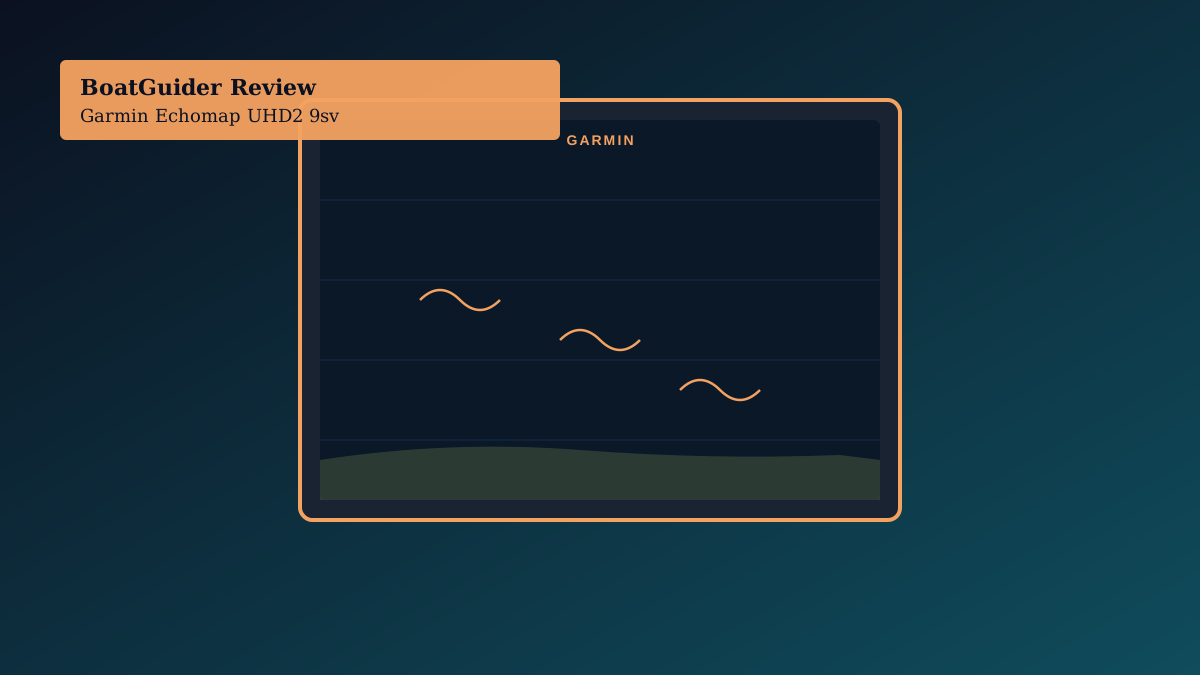
The Value Question
Marine electronics pricing has gotten absurd. A flagship GPSMAP 1242xsv with the same screen size as the Echomap UHD2 9sv costs $4,000, and the only meaningful difference for 90% of recreational boaters is radar support and a slightly brighter display. The Echomap UHD2 9sv, at $999 bundled with BlueChart g3, is Garmin's answer to the question: what if a chartplotter didn't cost more than the boat? See the Garmin Echomap UHD2 product line for current pricing and bundle options.
Display & Sunlight Readability
The 9-inch display is IPS LCD, rated at 800 nits. That's not as bright as the 1,000-nit panels on the GPSMAP line, but in practice, the UHD2 is fully readable in direct sun if you mount it angled slightly down. The backlight has 10 levels, and at level 4 it's comfortable for night running without wrecking your night vision.
One thing Garmin fixed on the UHD2 versus the original UHD: the touchscreen now works reliably with wet fingers. The original was notorious for ignoring touches the moment a wave came aboard. The UHD2 is no iPhone, but it's finally usable.
Sonar Performance
The GT56 transducer bundle is the real story. You get:
- Traditional 2D sonar at 50/77/200 kHz — clean, low-noise returns out to 1,500 feet
- ClearVü (down-scanning) at 455/800 kHz — photo-like structure detail
- SideVü (side-scanning) at 455/800/1000 kHz — out to 500 feet each side
- Quickdraw Contours — auto-mapping in real time
The 1000 kHz SideVü mode is the headline upgrade over the original UHD. It produces almost photographic detail on structure — you can distinguish a submerged tree from a rock pile from 200 feet away, which is a game-changer for freshwater anglers and structure-oriented inshore saltwater guys.
Recommended sonar settings (coastal, <100 ft depth):
  Frequency:        800 kHz (ClearVü + SideVü)
  Color gain:       Auto + 2
  Surface clarity:  Off (coastal water is turbid)
  Noise rejection:  Medium
  Scroll speed:     2/3 (matches 5-kt trolling speed)
Chartplotting & Navigation
The UHD2 ships with BlueChart g3 (coastal) or LakeVü g3 (inland), depending on bundle. Both integrate Garmin's Auto Guidance — you enter your boat's draft and bridge clearance, and the chartplotter routes you through water deep enough and under bridges tall enough. It's not infallible (always sanity-check with paper or NOAA raster charts), but it's saved me from a soft-bottom grounding twice. Our NOAA chart reading guide covers the symbols you'll see underneath the magenta line.
ActiveCaptain — Garmin's phone app integration — is genuinely useful. You can plan a route on your phone at the kitchen table, sync it to the boat over Wi-Fi, and have it waiting when you board. Firmware updates also push over Wi-Fi, which means no more SD-card shuffling.
LiveScope Compatibility
This is the feature that elevates the Echomap UHD2 from "good chartplotter" to "must-buy." LiveScope is Garmin's real-time forward-facing sonar — you see fish swimming 40 feet ahead of the boat, in motion, in real time. It's the biggest advance in fishing electronics since the LCD fishfinder.
The Echomap UHD2 9sv supports a single LiveScope sonar module. To use it you'll need:
- The LVS32 LiveScope sonar module (~$3,499)
- A LiveScope GLS10 sonar black box (~$1,499)
- A compatible transducer (LVS12, LVS32, or the new LVS34)
Total LiveScope bill: roughly $5,000 on top of the chartplotter. That sounds absurd until you've used it. For serious structure fishing — flounder on jetties, snook in mangroves, walleye on river bends — it's transformative.
What's Missing
- No radar support. If you need radar (offshore fog, Alaska, Pacific Northwest), you must step up to the GPSMAP line.
- No Ethernet networking between Echomap units. You can share waypoints via ActiveCaptain, but you can't network two Echomaps into a single sonar source the way GPSMAP units can.
- Single microSD slot. If you want both premium charts and Quickdraw recording, you're juggling cards.
Verdict
For the 90% of recreational boaters who don't need radar, the Echomap UHD2 9sv is the right answer. It's not the best chartplotter Garmin makes — it's the best chartplotter most people should buy. The combination of a bright 9-inch display, excellent sonar with 1000 kHz SideVü, full LiveScope compatibility, and ActiveCaptain cloud features at $999 is unmatched.
If you're outfitting a new boat, here's our recommendation: start with the UHD2 9sv and the included GT56. Add LiveScope only if you fish structure. If you later decide you need radar, sell the Echomap and step up to a GPSMAP — you'll lose about 30% on resale but you'll have spent less overall than buying GPSMAP from the start.
FAQ
Q: Can the Echomap UHD2 9sv connect to a Garmin radar?
No. The Echomap line does not support Garmin radar domes. If you need radar for fog or offshore navigation, you must step up to the GPSMAP line (GPSMAP 1242xsv or similar). This is the single biggest limitation of the Echomap series.
Q: Do I need a separate transducer for LiveScope?
Yes. LiveScope requires three components: the LVS32 sonar module ($3,499), the GLS10 black box ($1,499), and a LiveScope transducer (LVS12, LVS32, or LVS34). The GT56 transducer included with the Echomap handles traditional, ClearVü, and SideVü sonar but not LiveScope.
Q: What's the difference between the UHD and UHD2?
The UHD2 adds 1000 kHz SideVü (vs 455/800 kHz on the original UHD), a brighter 800-nit display, wet-finger touchscreen support, and Wi-Fi connectivity for ActiveCaptain. The original UHD is still a good unit if you can find it discounted, but the UHD2 is worth the premium for the improved SideVü alone.
Q: Can I network two Echomap UHD2 units together?
Not directly. The Echomap line does not support Ethernet networking like the GPSMAP line. You can share waypoints via ActiveCaptain (cloud sync), but you cannot share a single sonar source across multiple Echomap displays. If you need multi-display networking, step up to GPSMAP.
Q: Does the Echomap UHD2 work with NMEA 2000?
Yes. It has a built-in NMEA 2000 port that connects to engine data, fuel flow, autopilots, and other N2K sensors. This is one of the features that makes it suitable for serious anglers — you can display engine RPM, fuel burn, and even autopilot control on the same screen as your sonar. See our marine electrical systems guide for NMEA 2000 backbone wiring basics.
Read more marine electronics reviews on our reviews page, follow our marine electronics guides, or see our through-hull transducer installation guide. See our affiliate disclosure for how we make money on product links.
Keep reading
Related articles
 Reviews7m
Best Marine Batteries 2025: AGM vs Lithium vs Flooded
A practical comparison of flooded lead-acid, AGM, and LiFePO4 marine batteries with real-world cycle life, charge profiles, and 5-year cost analysis.
 Reviews6m
Boston Whaler 170 Montauk: The Indestructible Center Console
After 200 hours on a 2024 Boston Whaler 170 Montauk, here's our unfiltered take on ride quality, fishability, and whether the premium price is worth it.
 Guides6m
Marine Electrical Systems: Safe Power On The Water
Your boat's electrical system is the difference between a great day and a tow home. Learn 12V DC basics, battery management, and the 5 most common failures.