How to Read a NOAA Chart: A Practical Guide for New Boaters
Paper charts aren't dead. Learn the 12 symbols every coastal boater must know, how to interpret depth contours, and why your chartplotter can lie.
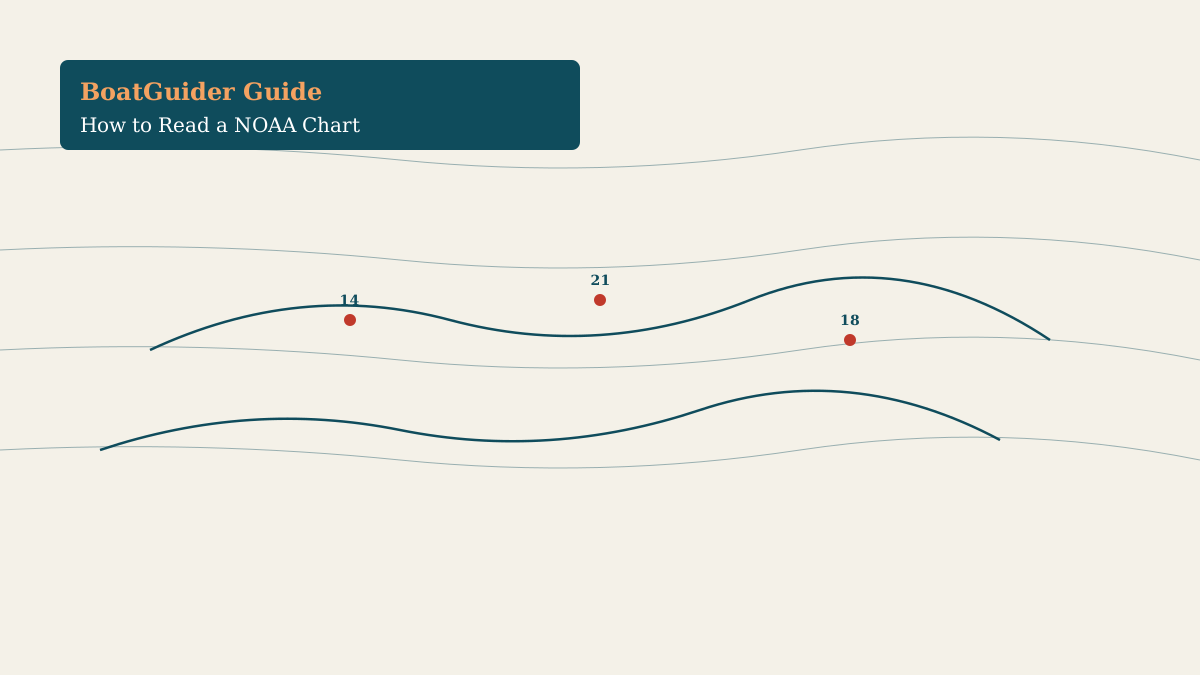
Why Paper Charts Still Matter
In 2019, the cargo ship MV Conductor ran aground on a reef in the Philippines. The cause wasn't weather or mechanical failure — it was a chartplotter that had been displaying an outdated electronic chart for three years. The crew trusted the screen.
The 12 Symbols You Must Know
1. Depth Numbers
Plain numbers in feet, fathoms, or meters (depending on the chart's units). The chart legend tells you which. On a NOAA chart in U.S. waters, depths are usually in feet for inshore areas and fathoms (6 feet = 1 fathom) for offshore.
Numbers with a tiny underline (e.g., 1̱4) are drying heights — they're above water at mean low water. The number tells you how high the rock or shoal sticks up at the lowest normal tide.
2. Depth Contours
Curved lines connecting points of equal depth. NOAA charts draw contours at 1, 2, 3, 5, 10, 20, 30, 60, 100, 200, and 400 fathoms (or feet, depending on chart). Closely spaced contours mean steep drop-offs — prime fishing but also prime grounding risk.
3. Rocks
- A solid asterisk
✳or*= rock that's always visible (above water at all tides) - A hollow asterisk
✳(open center) = rock that covers and uncovers with the tide - A dotted asterisk = rock that's submerged at all tides
- A plus sign
+= dangerous rock, often with depth noted nearby
When in doubt, treat every asterisk as if it's a plus sign. Reef and rock damage is the single most common insurance claim for recreational boats under 30 feet.
4. Wrecks
A fishbone symbol (ƜƜƜ) is a wreck. A dotted fishbone is a dangerous wreck that may be near the surface. Wrecks less than 20 meters deep in charted depths over 30 meters are considered hazards to navigation and have their own symbol set.
5. Channel Markers
Red triangles with a number = port-side markers (returning to port from seaward). Green squares with a number = starboard-side markers. The mnemonic is "Red Right Returning" — keep red on your right when coming back to port.
6. Buoys
A diamond shape with a small circle inside represents a buoy. The color and label inside the diamond tell you what kind:
RG= red and green (junction buoy)Y= yellow (special purpose)C= cautionary
7. Lighthouses
A magenta circle with a black dot in the center, often with a radiating flash pattern. The chart will also list the light's characteristics: color, flash pattern, period, and range.
8. Restricted Areas
Areas outlined in magenta with a label inside:
Restricted= entry limited (often military)Prohibited= no entryCaution= navigational hazard or naval activitySecurity Zone= Coast Guard-enforced exclusion (around naval vessels, ports)
9. Anchorage Areas
A magenta dashed circle or rectangle labeled Anchor or Anchorage. Inside these areas you may anchor; outside, anchoring may be prohibited or restricted by time. Our anchoring in wind and current guide covers how to actually set the hook once you've picked a spot.
10. Submarine Cables
A magenta line with the label Submarine Cable or a hatched line. Anchoring or trawling near these is illegal and will earn you a Coast Guard visit — and a bill if you snag the cable.
11. Traffic Separation Schemes
Arrows on the chart showing the direction of vessel traffic in busy shipping lanes. Small boats should cross traffic schemes at right angles (perpendicular), not run along them.
12. Magnetic Variation
A magenta line with a small compass rose at intervals, labeled with degrees east or west of true north. This is the difference between magnetic north (what your compass reads) and true north (what the chart is drawn to). You must apply this correction when plotting courses — see Wikipedia's article on magnetic declination for the underlying physics.
How to Plot a Course on Paper
Here's the absolute minimum procedure for plotting a course on a paper chart:
1. Identify your departure point (A) and destination (B).
2. Draw a straight line from A to B with a pencil.
3. Measure the distance using the chart's latitude scale
   (1 minute of latitude = 1 [nautical mile](/glossary/nautical-mile) — NEVER use the longitude scale).
4. Measure the true course [bearing](/glossary/bearing) from A to B using a parallel ruler or
   a Douglas protractor.
5. Apply magnetic variation: "True Virgins Make Dull Companions"
   (True + Variation = Magnetic; Magnetic + Deviation = Compass).
6. Note the course, speed, distance, and ETA in your logbook.
7. Identify waypoints and hazards along the route.
8. Brief your crew.
Reading the Tide Tables
Charts show depths at mean lower low water (MLLW) — the chart datum used on all NOAA U.S. charts. To find the actual depth at any time, you need the tide table for your nearest NOAA tide station.
Free Resources
- NOAA Booklet Charts — free PDF charts formatted for home printing: noaa.gov
- NOAA Tides & Currents — real-time and predicted tides: tidesandcurrents.noaa.gov
- USCG Local Notice to Mariners — weekly updates to charts: navcen.uscg.gov
The Chartplotter's Blind Spot
Modern chartplotters are incredible. They're also seductive — and that seduction gets boaters in trouble. Three things your chartplotter cannot reliably tell you:
- Whether a channel has shifted. Inlets and passes change shape with every storm. The chartplotter shows the chart as surveyed, which may be years out of date.
- Floating debris. Logs, shipping containers, and crab-pot buoys are not on any chart. Eyes on the water at all times.
- Other boats' intentions. AIS helps, but small boats don't have it. Visual lookout is non-negotiable. For distress communication when visual fails, a VHF radio is your primary tool.
The competent coastal navigator uses the chartplotter as a primary tool and paper as a sanity check. The expert navigator can do the reverse — and does, when the screen goes dark.
Want to dive deeper? Our seamanship guides cover VHF radio protocol, docking in wind, and anchor selection. Or contact us with your specific navigation question. Pair this guide with our VHF radio protocol guide and anchoring in wind and current for the full coastal-navigation toolkit.
Keep reading
Related articles
 Guides9m
Docking in Wind: 5 Techniques Every Boater Needs
Docking is the #1 source of boating anxiety. Learn 5 techniques: spring lines, warping, pivoting, ferry angle, and the emergency kamikaze abort.
 Guides7m
VHF Marine Radio Protocol: Complete Calling Guide
A working VHF radio is the single most important safety device aboard. Learn proper hailing, Channels 16/13/22A, Mayday calls, and DSC setup.
 Guides7m
Anchoring in Wind: Proven Techniques for Boaters
Anchoring is the single most underestimated skill in recreational boating. Learn the 7:1 scope rule, the Bahamian moor, and how to set in 30 knots.