Docking in Wind: 5 Techniques Every Boater Needs
Docking is the #1 source of boating anxiety. Learn 5 techniques: spring lines, warping, pivoting, ferry angle, and the emergency kamikaze abort.
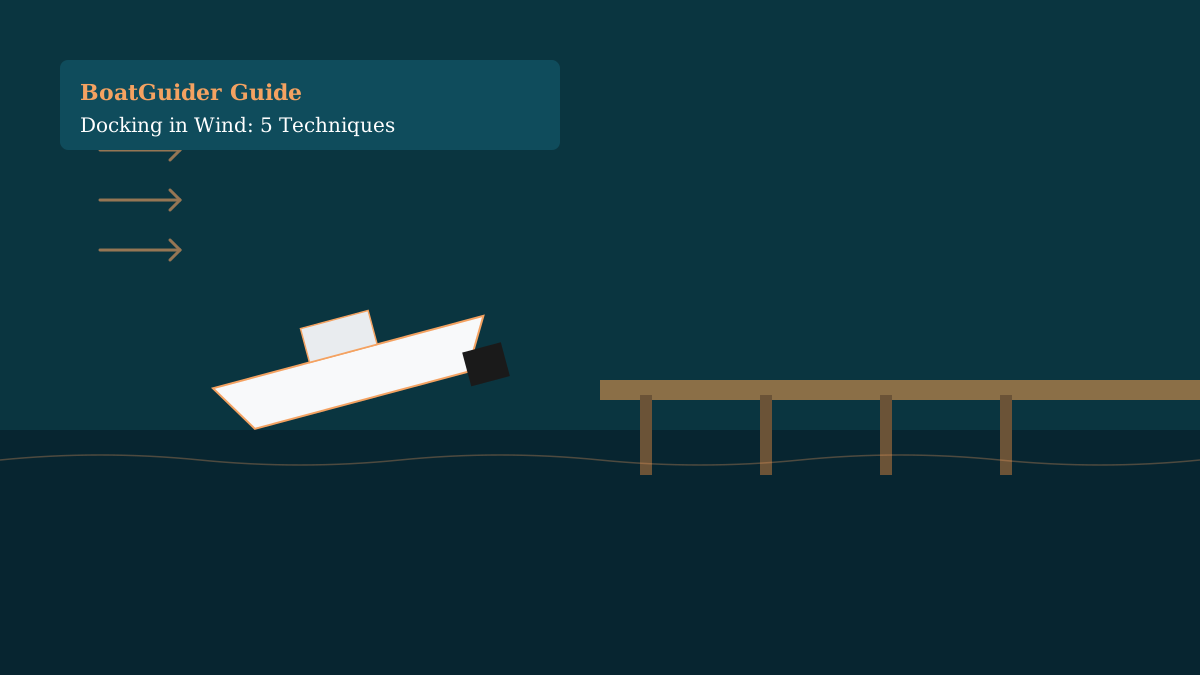
Why Docking Scares Everyone
More boats are damaged at the dock than anywhere else. Insurance data shows that 60% of recreational vessel claims under $10,000 involve contact with a dock, piling, or another boat while docking. The reason is simple: docking requires you to slow down (removing rudder authority) while approaching a solid object (the dock) in a vessel that weighs several thousand pounds and has no brakes.
Here's a quick reference for all five techniques — when to reach for each, and the core principle behind it. We'll walk through each one in detail below.
| Technique | When to Use | Key Principle |
|---|---|---|
| Spring Line | Routine dock approach in any wind | Pivot the boat against a midship line using slow forward gear |
| Warping | Tight slips with no room to maneuver under power | Walk the boat along the dock with lines, no engine thrust |
| Pivot Turn | Turning around in a narrow channel or fairway | Use prop walk with short ahead/astern bursts to rotate in place |
| Ferry Angle | Wind blowing you off the dock | Point bow upwind so wind pushes the boat sideways toward the dock |
| Kamikaze (Abort) | Approach goes wrong, any unsafe situation | Full power away from the dock, reset, and try again |
Technique 1: The Spring Line (Your Best Friend)
The spring line is the single most important docking tool. It's a line run from a midship cleat on your boat to a cleat on the dock, angled forward or aft. When you put the engine in gear against a spring line, the boat pivots cleanly into the dock instead of drifting.
Here's how to use it:
- Approach the dock at a shallow angle (15-20 degrees) against the direction the wind is pushing you.
- Have a crew member step off with the midship spring line when the bow is within 3 feet of the dock. Do NOT step off until the boat is nearly stopped.
- Cleat the spring line on the dock and back to the boat's midship cleat.
- Put the engine in slow forward with the wheel turned toward the dock. The boat will pivot cleanly against the dock, bow and stern both coming in.
- Idle in gear while crew secures the bow and stern lines.
Technique 2: Warping (When There's No Room to Approach)
Warping is the technique of using lines to pull the boat into or out of a tight space without engine power. It's how tall ships moved in harbors for centuries, and it's still useful when you're in a tight slip with boats on both sides.
- Get a line to the dock — either by tossing a heaving line or having a crew member step off when close.
- Run a line from the bow to a dock cleat forward of your position.
- Pull the boat forward along the dock by taking in the line. The boat moves like a horse on a lead rope.
- Use a stern line to control the back end — a crew member on the dock can walk the stern line along to keep the boat parallel.
Warping is slow, but it's the only technique that works when there's literally no room to maneuver under power.
Technique 3: The Pivot Turn (Turning in a Narrow Channel)
When you need to turn around in a narrow channel or fairway, the pivot turn is your tool. It uses prop walk (the sideways force of the propeller) to rotate the boat in its own length. The Wikipedia article on prop walk explains the underlying physics.
Right-hand prop (most boats):
  1. Hard right rudder, ahead 2 seconds → bow swings right, stern kicks left
  2. Neutral, hard left rudder, astern 2 seconds → prop walk kicks stern right,
     rudder pushes bow left
  3. Repeat until you've rotated 180 degrees

Left-hand prop (less common):
  Reverse the rudder directions above.
The key is short bursts of power — 2 seconds at a time, then neutral. Never hold the throttle for more than 3 seconds or you'll build too much momentum.
Technique 4: The Ferry Angle (Handling Crosswind)
When the wind is blowing you off the dock, you need a ferry angle. This is the angle at which you point the bow UPWIND so that the wind pushes the boat sideways toward the dock while you maintain forward motion.
- Assess the wind direction — look at flag, ripples on the water, or smoke from shore.
- Approach at 30-45 degrees UPWIND of the dock. If the wind is blowing from right to left, approach from the right, pointing the bow into the wind.
- Maintain enough speed to hold the angle — typically 2-3 knots. Too slow and the wind wins; too fast and you hit the dock.
- As you near the dock, reduce speed gradually. The wind will push you sideways the last few feet.
- Have fenders deployed on the downwind side — that's the side that will contact the dock. Fenders are the inflatable bumpers that prevent hull damage on contact.
Technique 5: The Kamikaze (Emergency Abort)
Sometimes you misjudge the wind, the current, or your speed, and the approach goes wrong. The kamikaze is the emergency abort: a full-power burst away from the dock to reset and try again.
- Recognize the bad approach early. If you're closing too fast, too sideways, or too far off angle — abort. Don't try to save it.
- Hard rudder away from the dock, full throttle ahead for 2-3 seconds. This kicks the bow away and builds steerage.
- Once clear, reduce to idle and reassess. Circle around, re-read the wind, and try again.
- No shame in going around. I've gone around 4 times in a 25-knot crosswind. The dock didn't go anywhere.
Reading the Elements
Before any docking approach, take 30 seconds to read the conditions:
- Wind: Look at the water. Ripples, whitecaps, and flag direction tell you wind speed and direction. Wind pushes the boat — especially the bow, which has more windage. For official marine weather, monitor NOAA marine forecasts.
- Current: Look at the water near the dock. Current moves water past fixed objects. If there's current, it affects your boat more than wind does. Verify predictions at NOAA Tides & Currents.
- Dock configuration: Is it a floating dock or fixed? Are there pilings or a continuous face? Is there a boat already tied up on the next slip?
Practice Drills
Docking is a perishable skill. Practice these in calm conditions:
- The slow pass. Approach the dock at idle, parallel, 10 feet off. Hold a straight line for 100 feet. This teaches throttle and rudder coordination.
- The stop. Approach the dock at 3 knots. Stop the boat exactly at a marked point using neutral and brief reverse bursts. This teaches momentum control.
- The spring line pivot. Approach, step off with a spring line, and pivot the boat against the dock using engine power. This is the technique you'll use 80% of the time.
- The abort. Approach, then execute a full abort at 20 feet. This builds the muscle memory to abort when things go wrong.
FAQ
Q: What if I'm docking alone?
Use a spring line rigged and ready before you approach. Approach slowly, step off with the spring line yourself, and use the engine to pivot. Never jump off a moving boat — come to a full stop first, then step off.
Q: Should I use both engines when docking a twin-screw boat?
Use one engine at a time. Twin-screw boats turn by using opposite engines (one forward, one reverse) — this is called "splitting the throttles." Using both engines together just makes you go straight. Practice using one engine at a time to master close-quarters maneuvering.
Q: What's the biggest mistake new boaters make docking?
Going too fast. Speed gives you control, but it also gives you momentum. The correct approach speed is "barely making way" — 0.5 to 1 knot. If you can read the name on the dock cleat as you approach, you're going the right speed.
Q: How do I dock in a strong current?
Current beats wind every time. If the current is pushing you toward the dock, approach slowly and let the current do the work. If it's pushing you away, approach with more speed and use a spring line to hold the boat in once you make contact.
Q: When should I use fenders vs. fender boards?
Fenders (the standard inflatable bumpers) are fine for most docks. Fender boards (a horizontal plank hung outside the fenders) are for rough docks with pilings or uneven surfaces — they spread the load across multiple fenders and prevent the boat from rolling under a piling. See Wikipedia's fender article for the full taxonomy.
Master docking and you'll enjoy boating twice as much. For more seamanship skills, read our VHF radio protocol guide, anchoring guide, and first-boat buying guide for beginner-friendly context.
Keep reading
Related articles
 Guides7m
Anchoring in Wind: Proven Techniques for Boaters
Anchoring is the single most underestimated skill in recreational boating. Learn the 7:1 scope rule, the Bahamian moor, and how to set in 30 knots.
 Guides6m
Winterizing Your Boat: The Complete Off-Season Checklist
Proper winterization prevents $5,000+ in freeze damage. Learn the 12-step process from engine fogging to antifreeze that keeps your boat safe all winter.
 Guides7m
Sail Trim Basics: More Speed and Balance
Sail trim is the art of adjusting sails for the wind. Learn to read telltales, understand the slot effect, and trim for pointing vs reaching in this guide.