VHF Marine Radio Protocol: Complete Calling Guide
A working VHF radio is the single most important safety device aboard. Learn proper hailing, Channels 16/13/22A, Mayday calls, and DSC setup.
Why VHF, Not a Cell Phone
A cell phone is a one-to-one device. A VHF radio is one-to-many. When you call for help on Channel 16, every boat within range hears you — including the Coast Guard, the volunteer tow services, and any nearby Good Samaritan. A cell phone call reaches exactly one person.
VHF also gives you weather (Channel WX1-3), bridge-to-bridge communication (Channel 13), and direct Coast Guard working channels (Channel 22A). A cell phone gives you nothing on the water that the VHF doesn't do better. For the official channel reference, see the USCG Navigation Center VHF page.
Required Equipment
For U.S. recreational vessels, the practical minimum:
- A fixed-mount, 25-watt VHF radio with DSC (Digital Selective Calling). Handhelds (5-6 watts) are a fine backup but limited to line-of-sight.
- An antenna mounted as high as possible. VHF is line-of-sight; antenna height matters more than radio power.
- A registered MMSI number programmed into the radio. Free from BoatUS, Sea Tow, or the FCC (for international waters).
- A GPS connection so your DSC distress call includes your position automatically.
The Channels You Actually Use
Most recreational boaters use about six channels. Memorize them.
| Channel | Use | Notes |
|---|---|---|
| 16 | Distress, safety, hailing | Monitored by USCG and most vessels. Switch to working channel after contact. |
| 13 | Bridge-to-bridge | Required for navigation safety. Talk to commercial vessels, lockmasters, bridge tenders. |
| 22A | USCG working | The Coast Guard will direct you here from 16 for non-emergency traffic. |
| 9 | Hailing (alternative) | Some regions prefer 9 for non-emergency hailing; check local custom. |
| 68, 69, 71, 72, 78 | Recreational working | Switch here after hailing on 16 or 9. |
| WX1, WX2, WX3 | Weather | Continuous NOAA weather broadcast. See NOAA Weather Radio for station coverage. |
How to Make a Routine Call
The standard hailing procedure, step by step:
1.  Listen on Channel 16 for 10 seconds to ensure no distress traffic.
2.  Say the name of the vessel you're calling, twice.
3.  Say "this is" followed by your vessel name, once.
4.  Say "over" and release the mic.

Example:
    "Mariner, Mariner, this is Wind Dancer. Over."

5.  When they respond, switch to a working channel:
    "Mariner, switch to channel 68. Over."

6.  On channel 68, re-establish contact:
    "Mariner, this is Wind Dancer on 68. How do you read?"

7.  When done: "Wind Dancer, clear."
Distress Calls: Mayday vs. Pan-Pan vs. Sécurité
Three levels of urgency, in descending order:
MAYDAY — Grave and imminent danger, immediate assistance required
Use when: the boat is sinking, on fire, someone is having a heart attack, you're taking on water faster than the bilge can handle.
1.  MAYDAY, MAYDAY, MAYDAY.
2.  This is [vessel name] (three times).
3.  MMSI number and call sign (once).
4.  Position (lat/long or bearing/range from a known point).
5.  Nature of distress (e.g., "sinking," "medical emergency").
6.  Number of persons on board.
7.  Description of vessel (length, color, hull type).
8.  Any other useful info (weather, abandon-ship intent).
9.  "OVER."

Example:
    "MAYDAY MAYDAY MAYDAY.
     This is S/V Ardent, S/V Ardent, S/V Ardent.
     MMSI 367123456.
     Position: 34°12.5' N, 077°45.2' W, approximately 3 miles east of
     Masonboro Inlet.
     Nature: Taking on water, bilge pumps cannot keep up.
     Four persons on board.
     Vessel is a 32-foot white sailboat, blue canvas.
     We have life jackets and an inflatable raft ready.
     OVER."
PAN-PAN — Urgent situation, but not immediately life-threatening
Use when: you've lost engine and are drifting toward a lee shore, but no immediate danger of sinking; someone has a serious but non-life-threatening injury.
Same format as MAYDAY but say "PAN-PAN, PAN-PAN, PAN-PAN" (pronounced "pahn-pahn") instead.
SÉCURITÉ — Safety warning to other vessels
Use when: you see a floating log in a shipping channel, a partially submerged container, or any hazard to navigation.
"SÉCURITÉ, SÉCURITÉ, SÉCURITÉ.
 This is S/V Ardent.
 All vessels in the vicinity of Cape Lookout Shoals, be advised:
 large floating log reported at 34°35' N, 076°15' W.
 Hazardous to navigation. Out."
Digital Selective Calling (DSC)
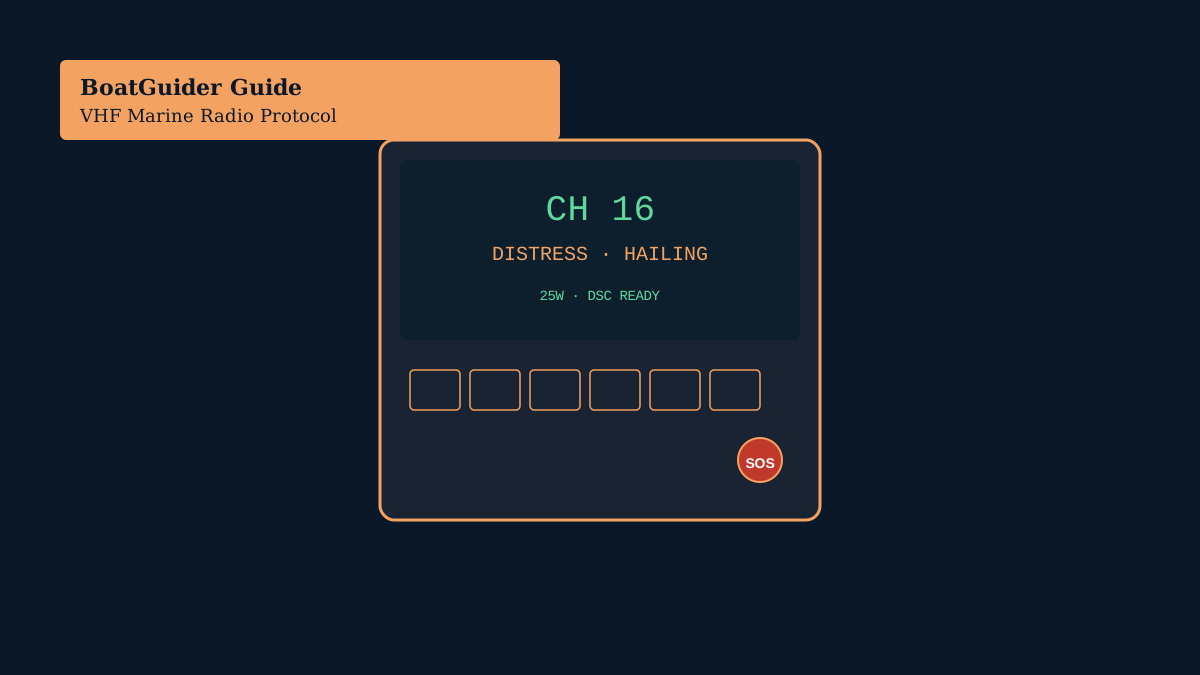
DSC is the marine equivalent of speed dialing. Push the red DISTRESS button on a DSC-equipped radio and the radio broadcasts a digital distress alert on Channel 70, including your MMSI, your position (if GPS-connected), and the time. The Coast Guard receives this instantly and acknowledges on Channel 16.
Setting Up DSC
- Get an MMSI number. Free from BoatUS (boats staying in U.S. waters) or the FCC (international). For a foreign-flagged or internationally-cruising vessel, use the FCC ULS system.
- Program the MMSI into your radio. This is a one-time operation — most radios lock the number after entry. Follow your radio's manual exactly.
- Connect GPS. Most modern fixed-mount radios accept NMEA 0183 or NMEA 2000 GPS input. Without GPS, your distress call has no position, which is useless to the Coast Guard.
- Register your MMSI. BoatUS maintains the U.S. recreational database; the FCC maintains the international one. Make sure your vessel description, emergency contact, and phone numbers are accurate.
Radio Checks — Do It Right
Never call "Coast Guard, radio check" on Channel 16. The USCG does not perform radio checks. Use one of these instead:
- Sea Tow Automated Radio Check on Channel 26, 27, or 28 (varies by region — check Sea Tow's website for your local channel). An automated system responds and replays your transmission so you can hear your signal quality.
- Call a marina or fellow boater on a working channel.
Practical Drills
If you're a new VHF owner, do these in this order:
- Read your radio's manual. Every radio is slightly different. Know where the DISTRESS button is, how to switch channels, and how to change power (1W vs 25W).
- Program your MMSI as soon as you get the number.
- Do a radio check with a known shore station.
- Practice a mock Mayday call while anchored. (Do NOT transmit on 16. Say it out loud to yourself, with the mic keyed but on a low-power working channel — then immediately say "cancel.")
- Brief every crew member on the location of the DISTRESS button and the contents of your boat's Mayday script (which should be written on a waterproof card and kept at the helm).
A VHF radio you don't know how to use is worse than no radio at all. Take 30 minutes this weekend and learn yours. Pair it with our NOAA chart reading guide and anchoring in wind and current for the full coastal-safety toolkit.
For more on safety equipment, see our boat buying guide or read our NOAA chart reading guide. For close-quarters handling under pressure, see our docking in wind techniques and anchoring guide.
Keep reading
Related articles
 Guides9m
Docking in Wind: 5 Techniques Every Boater Needs
Docking is the #1 source of boating anxiety. Learn 5 techniques: spring lines, warping, pivoting, ferry angle, and the emergency kamikaze abort.
 Guides6m
How to Read a NOAA Chart: A Practical Guide for New Boaters
Paper charts aren't dead. Learn the 12 symbols every coastal boater must know, how to interpret depth contours, and why your chartplotter can lie.
 Guides7m
Anchoring in Wind: Proven Techniques for Boaters
Anchoring is the single most underestimated skill in recreational boating. Learn the 7:1 scope rule, the Bahamian moor, and how to set in 30 knots.