Anchoring in Wind: Proven Techniques for Boaters
Anchoring is the single most underestimated skill in recreational boating. Learn the 7:1 scope rule, the Bahamian moor, and how to set in 30 knots.
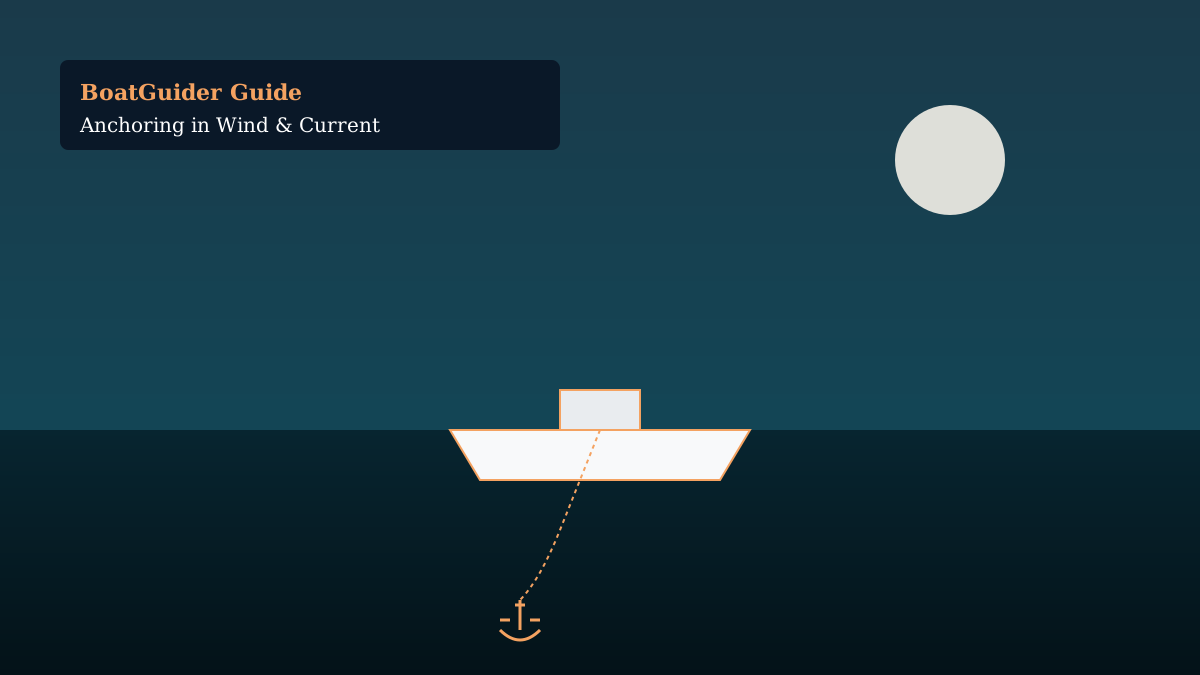
Why Anchoring Matters More Than You Think
In 2023, the Coast Guard attributed 14% of recreational vessel losses to "anchoring failure" — the anchor dragged, the boat went aground, and the hull was lost. That's more than engine failure (11%) and nearly as many as collisions (17%), according to the USCG Recreational Boating Statistics report.
The good news: anchoring is a learnable, repeatable skill. It's not art, it's technique. Here it is.
The Anchor
Different bottoms need different anchors. There is no universal anchor. The right choice depends on where you'll spend most of your time:
| Bottom type | Best anchor | Holding power |
|---|---|---|
| Mud | Danforth, Fortress | Excellent |
| Sand | CQR, Delta, Rocna | Excellent |
| Grass/weeds | Spade, Rocna | Good (must dig through) |
| Rock | Grapnel, Bruce | Fair (may not reset) |
| Mixed/coral | Rocna, Supreme | Good |
The Rode
The rode is the line/chain connecting the anchor to the boat. The two extremes:
- All-chain rode: Heavy, abrasion-resistant, holds the anchor shank down. Best for boats over 30 feet. No stretch, so it transmits shock to the anchor.
- All-line rode: Light, stretchy, easy to handle. Best for small boats. Lacks abrasion resistance and the catenary effect that helps the anchor set.
The compromise most recreational boaters use is 30 feet of chain spliced to nylon line. The chain provides weight to keep the anchor shank flat and abrasion resistance near the bottom; the nylon provides stretch to absorb wave shock.
For boats under 25 feet, 6 feet of chain is the practical minimum. For 25-35 feet, 15-30 feet. For 35+ feet, all-chain is the right answer.
The 7:1 Scope Rule
Scope is the ratio of rode length to water depth (plus the height from the waterline to the bow roller). The rule:
7:1 scope for overnight or strong wind. 5:1 for lunch. 3:1 only in calm, shallow water with a known bottom.
Why 7:1? Because the anchor only holds when the pull is horizontal. At 3:1 scope, the pull angle is about 18 degrees from horizontal — the anchor will pull out. At 7:1, the pull angle is about 8 degrees — the anchor sets deeper.
How to Set an Anchor (Step by Step)
1.  Identify your swing circle:
    radius = water depth + bow height × scope + boat length.
    Make sure nothing is within that circle (rocks, other boats, shore).

2.  Approach your intended spot slowly, heading into the wind or current
    (whichever is stronger). Stop the boat.

3.  Lower the anchor to the bottom — do NOT throw it. Throwing tangles
    the rode and may damage the anchor.

4.  Let the boat drift backward as you pay out rode. Pay out 3x the
    water depth first, then cleat off briefly to "test" the anchor.

5.  With the rode cleated, put the engine in slow reverse. Watch the
    rode — it should snap taut, then stretch slightly. If it skips or
    bounces, the anchor isn't set. Pull it up and try again.

6.  Once set, pay out to your final scope (7:1 for overnight). Take
    bearings on two landmarks (a chimney and a dock piling). Note them.

7.  Check the bearings 15 minutes later. Then 30 minutes later. Then
    hourly overnight. If the bearings change, you're dragging.
</Callout>

## The Bahamian Moor (Two Anchors Off the Bow at 60°)

When the current reverses (as it does twice a day in tidal areas — verify the slack water timing on [NOAA Tides & Currents](https://tidesandcurrents.noaa.gov/)), a single anchor boat will swing 180 degrees. In a crowded anchorage, this can put you into another boat. The Bahamian moor solves this.

Set two anchors off the bow, 60 degrees apart, with about 7:1 scope on each. As the current reverses, the boat stays roughly in place, pivoting around the two rodes. You need twice the [ground tackle](/glossary/ground-tackle) and twice the patience, but you use 1/3 the swing room.

## The Forked Moor (Bow and Stern)

When you need to keep the boat pointed in a specific direction — typically to face into an incoming swell or to fit in a narrow creek — set one anchor off the bow and one off the stern. The rodes form a V.

**Never** do this in open water or where the wind could shift 90+ degrees. A wind shift will put the swell on your beam and the boat will roll violently. Forked moors are for sheltered, narrow anchorages only.

## Anchoring in 30+ Knots

Storm anchoring is a different game. The techniques:

1. **Use more scope.** In strong wind, go 10:1 or even 15:1 if you have swinging room. The longer the rode, the more stretch and the lower the pull angle.

2. **Use a snubber.** A snubber is a length of nylon line attached to the chain with a rolling hitch or chain hook, then cleated to the boat. It absorbs shock and prevents the chain from jerking the anchor out.

3. **Set a second anchor.** If the wind is forecast to exceed 35 knots, set a second anchor 45 degrees off the bow on a separate rode. The second anchor shares the load and provides backup if the first drags.

4. **Engine on standby.** If the anchor drags in storm conditions, you need to be able to power up immediately. Don't turn the engine off overnight if the wind is over 25 knots — leave it in idle standby.

5. **Anchor watch.** Set an alarm for every 2 hours. Check the bearings. Check the GPS anchor alarm (most chartplotters have one — set it to alarm if you drift more than 100 feet from your anchor [waypoint](/glossary/waypoint)).

<Callout variant="danger" title="When to abandon the anchor">
If the anchor is dragging and you cannot reset it, **do not stay**. Pull the anchor and motor to a safer spot, even in the dark. A boat under power in 30 knots is far safer than a boat on a dragging anchor in 30 knots.
</Callout>

## Common Mistakes

After 25 years of watching boaters anchor, here are the mistakes I see most often:

1. **Insufficient scope.** 3:1 in 20 feet of water. See above.
2. **No chain.** All-line rode won't set the anchor properly in anything but mud.
3. **Throwing the anchor.** Tangles the rode, fouls the flukes.
4. **No bearing check.** Boaters assume the anchor is set, go below, and wake up on a reef.
5. **Wrong anchor for the bottom.** A Danforth in rock won't hold. A grapnel in mud won't hold. Match the anchor to the bottom.
6. **Cleating the rode wrong.** Use a proper cleat hitch — figure-8 with a half-hitch. A wrapped cleat will jam under load.
7. **No snubber.** In any chop, the chain jerks the anchor out. Always use a snubber.

## Practice

Anchoring is a perishable skill. Practice it. Pick a calm day, go to a known anchorage, and set your anchor 10 times. Each time, note how long it takes to set, what scope you used, and whether it held under reverse. After 10 reps, you'll be better than 80% of recreational boaters.

Then do it again at dusk. Then in 15 knots of wind. Then in 25. The skill compounds. For more close-quarters boat handling practice, pair this with our [docking in wind techniques](/blog/docking-in-wind-techniques) guide.

---

*For more seamanship techniques, read our [VHF radio guide](/blog/vhf-marine-radio-protocol-guide), [NOAA chart reading guide](/blog/how-to-read-noaa-chart), or our [first-boat buying guide](/blog/choosing-your-first-boat-guide).*Keep reading
Related articles
 Guides9m
Docking in Wind: 5 Techniques Every Boater Needs
Docking is the #1 source of boating anxiety. Learn 5 techniques: spring lines, warping, pivoting, ferry angle, and the emergency kamikaze abort.
 Guides6m
How to Read a NOAA Chart: A Practical Guide for New Boaters
Paper charts aren't dead. Learn the 12 symbols every coastal boater must know, how to interpret depth contours, and why your chartplotter can lie.
 Guides7m
VHF Marine Radio Protocol: Complete Calling Guide
A working VHF radio is the single most important safety device aboard. Learn proper hailing, Channels 16/13/22A, Mayday calls, and DSC setup.