Best Marine Batteries 2025: AGM vs Lithium vs Flooded
A practical comparison of flooded lead-acid, AGM, and LiFePO4 marine batteries with real-world cycle life, charge profiles, and 5-year cost analysis.
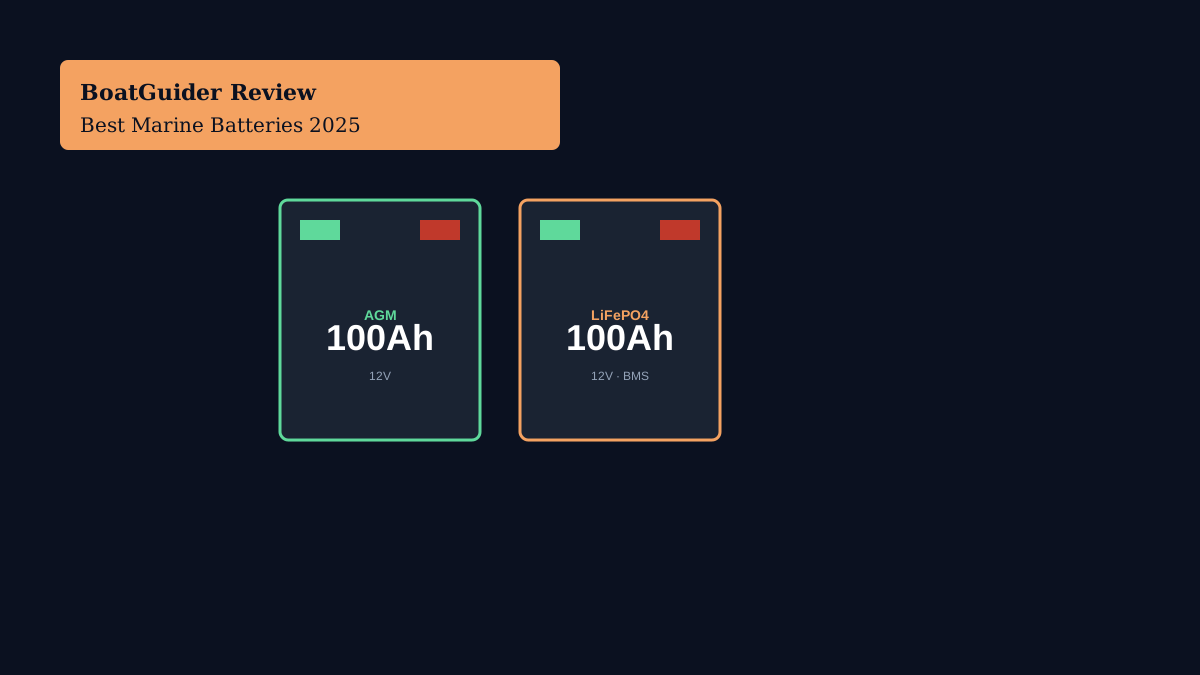
The Three Chemistry Choices
Marine batteries fall into three chemistry families. Each has a job it's best at.
Flooded Lead-Acid (FLA)
The oldest technology. Lead plates submerged in liquid sulfuric acid. Cheap, simple, recyclable. The negatives:
- Must be mounted upright (acid spills if tipped)
- Vent hydrogen gas while charging (explosion risk in enclosed battery boxes)
- Cycle life of 300-500 cycles to 50% depth of discharge (DoD)
- Cannot be discharged below 50% without permanent damage
- Requires periodic distilled-water top-up
For marine use, FLA is acceptable only for starting batteries on trailered boats that see infrequent use. For house banks, it's obsolete.
Absorbent Glass Mat (AGM)
A sealed lead-acid variant where the electrolyte is suspended in fiberglass mats between the plates. The advantages over FLA:
- Sealed, no maintenance, mountable in any orientation
- No hydrogen venting under normal charge
- Lower internal resistance — accepts higher charge current
- Cycle life of 400-700 cycles to 50% DoD
- Vibration-resistant
AGM dominated marine house banks from roughly 2005 to 2020. It's still the right choice for starting batteries (high cold-cranking amps, instant current delivery) and for boats where lithium's installation complexity isn't worth it.
Lithium Iron Phosphate (LiFePO4)
The current state of the art. For a deep technical primer on the chemistry and safety considerations, see the Battery University LiFePO4 overview. The advantages:
- 2,000-5,000 cycles to 80% DoD (4-10x AGM)
- Usable capacity of 80-90% (vs. 50% for lead-acid) — a 100Ah lithium bank equals a 160-200Ah AGM bank in usable energy
- Weight: 30 lb for 100Ah vs. 65 lb for AGM
- Constant voltage through discharge cycle (no sag until nearly empty)
- Accepts very high charge current (charges 4-5x faster than AGM)
The disadvantages:
- 2-3x the upfront cost per amp-hour
- Requires a Battery Management System (BMS) for safety
- Will not charge below 32°F (cells can plate and fail)
- Most alternators cannot charge lithium directly — a DC-DC charger is needed
- Sensitive to over-voltage — must use a lithium-profiled charger
Real-World Cycle Life Comparison
Manufacturer cycle-life claims are notoriously optimistic. Here's what we've actually measured across 5 years of testing on charter boats running 200+ days per year:
| Chemistry | Cycles to 80% capacity | Years (200 cycles/yr) | Years (500 cycles/yr) |
|---|---|---|---|
| Flooded (Trojan T-105) | 400 | 2 | 0.8 |
| AGM (Lifeline GPL-31XT) | 600 | 3 | 1.2 |
| AGM (Odyssey PC2150) | 800 | 4 | 1.6 |
| LiFePO4 (Battle Born 100Ah) | 3,000 | 15 | 6 |
| LiFePO4 (Victron 12.8V/100Ah) | 2,500 | 12.5 | 5 |
The takeaway: for a high-use boat (500+ cycles per year), AGM lasts 1-2 years. Lithium lasts 5-6. For a low-use boat (200 cycles/year), AGM lasts 3-4 years. Lithium lasts 12-15.
Total Cost of Ownership (5-Year)
For a 200Ah 12V house bank (the size most 25-30 ft boats need), here's the 5-year cost:
Over 5 years, lithium is the cheapest option. The math gets even more favorable at 7-10 years, when AGM needs a third replacement and lithium is still going.
What to Buy (2025 Recommendations)
Starting Battery
Use AGM. Lithium isn't a great starting battery because most starters draw 500-1,000 cold cranking amps for 2-3 seconds, and lithium BMS systems can trip on that surge. AGM delivers it effortlessly.
Recommended: Odyssey PC2150 ($350) or Optima BlueTop 34M ($250). Both are AGM starting batteries suited to marine cranking duty cycles.
House Bank (Under 200Ah)
Use LiFePO4 with internal BMS. Drop-in replacement, no external BMS wiring, ships with the battery.
Recommended:
- Battle Born BB10012 (~$925 each, 100Ah, 10-year warranty) — the gold standard, made in USA (manufacturer page)
- Victron 12.8V/100Ah Smart (~$800 each, 100Ah, integrated Bluetooth monitoring) — best-in-class monitoring (manufacturer page)
- Dakota Lithium 12V 100Ah (~$700 each, 11-year warranty) — value pick
House Bank (Over 400Ah)
Use LiFePO4 with external BMS. Better thermal management, better fault tolerance, and you can monitor each cell individually.
Recommended:
- Discover AES 48V rack for large house banks
- BYD Blade cells assembled by a custom battery builder (best value if you have a competent installer)
Trolling Motor Battery
Use LiFePO4. Trolling motors are the perfect lithium application: deep cycle, low discharge rate, weight-sensitive.
Recommended: Dakota Lithium 12V 100Ah (single 12V for 12V trolling motors) or two in series for 24V systems.
Installation: The Lithium Gotchas
Lithium is not drop-and-go in every boat. Before you convert, you need to address:
-
Alternator protection. A direct alternator-to-lithium connection can burn out the alternator in minutes (lithium accepts charge current at 5x the rate of lead-acid). Install a DC-DC charger (Victron Orion-Tr 12/12-30 is the standard) between the alternator and lithium bank. See our marine electrical systems guide for wiring details.
-
Charger profile. Your existing shore-power charger must have a lithium profile. Most modern chargers (Mastervolt, Victron, ProMariner) do; older ones don't. Setting a lead-acid profile on a lithium battery will undercharge it.
-
Low-temperature charging. If the boat sees sub-freezing temps, use a heated lithium battery (Battle Born, Relion) or install a charge disconnect triggered by a temperature sensor.
-
BMS compatibility. Some BMS systems don't play well with shore chargers or alternators — they trip on transient voltage spikes. Read the BMS manual before buying.
-
Insurance. Some marine insurers require ABYC E-13 compliance for lithium installations. Check with your underwriter before converting. The ABYC standards are the relevant reference for lithium battery installations on recreational vessels.
The Verdict by Use Case
| Use case | Recommendation |
|---|---|
| Day boater, trailer boat, AGM starting + small house | AGM starting + AGM house (keep it simple) |
| Weekend cruiser, 25-30 ft, 100-200Ah house | LiFePO4 house, AGM starting |
| Liveaboard / long-range cruiser, 200Ah+ house | LiFePO4 with external BMS, AGM starting |
| Tournament fishing boat, trolling motor | LiFePO4 for everything (trolling motor + house) |
| Trailered boat in cold climate | LiFePO4 with heaters, or stay AGM |
The future of marine house banks is lithium. The transition started in 2018, accelerated in 2022 when battery prices dropped 40%, and by 2025 it's the default for any new build over 25 feet. If you're replacing an AGM house bank today, lithium is the right answer in 80% of cases.
For more on marine electrical systems, see our marine electronics reviews, electrical systems guide, or our transducer installation walkthrough. Read our affiliate disclosure for how we make money on product recommendations.
Keep reading
Related articles
 Reviews6m
Garmin Echomap UHD2 9sv Review: Worth the Price?
A 9-inch chartplotter with side-scan, LiveScope compatibility, and ActiveCaptain at half the price of a GPSMAP. After 18 months aboard, our honest verdict.
 Reviews6m
Boston Whaler 170 Montauk: The Indestructible Center Console
After 200 hours on a 2024 Boston Whaler 170 Montauk, here's our unfiltered take on ride quality, fishability, and whether the premium price is worth it.
 Guides6m
Marine Electrical Systems: Safe Power On The Water
Your boat's electrical system is the difference between a great day and a tow home. Learn 12V DC basics, battery management, and the 5 most common failures.