Boat Trailer Maintenance: The Complete Annual Checklist
A neglected trailer is the #1 cause of roadside breakdowns. Learn the 12-point annual inspection and 5 pre-trip checks that prevent 90% of failures.
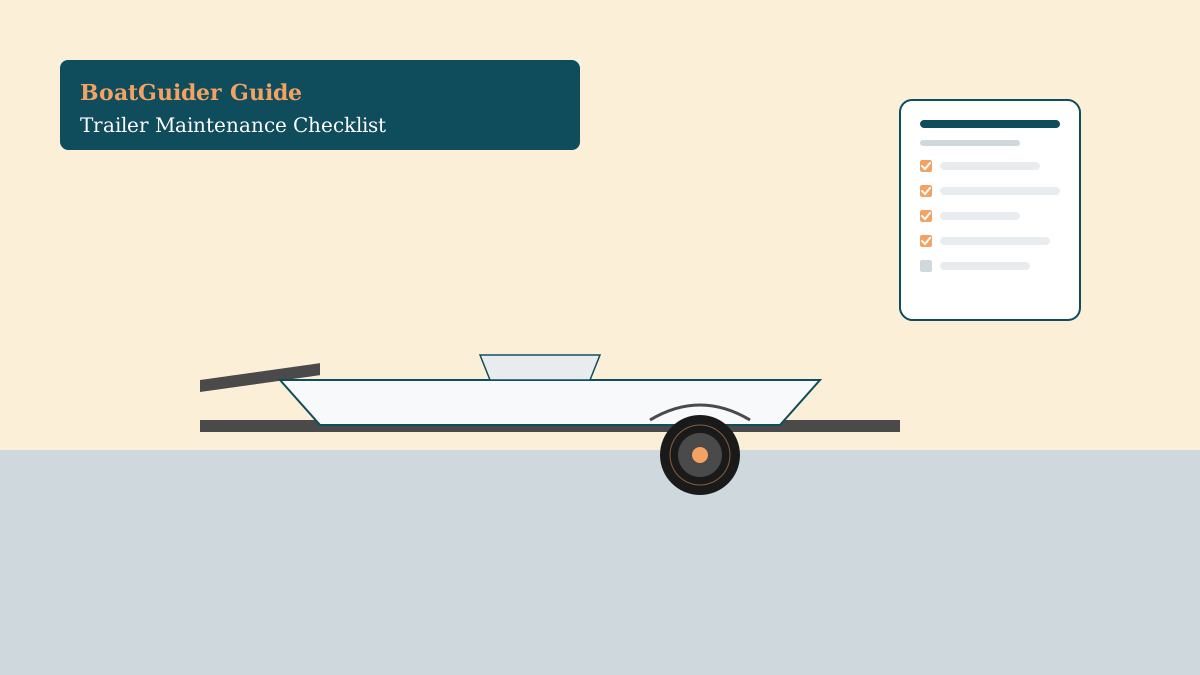
Why Trailer Maintenance Matters
The boat trailer is the most neglected piece of equipment in recreational boating. It's also the most likely to fail catastrophically. A blown tire at 65 mph with a 3,000-pound boat on top is not a minor inconvenience — it's a life-safety event.
The 12-Point Annual Inspection
Once a year — ideally before the season starts — perform this complete inspection. It takes 2-3 hours and costs $50-100 in parts. Skipping it costs $500-3,000 in roadside repairs and tow bills.
Here's the full 12-point inspection as a quick-reference checklist you can print and bring to the garage:
| # | Item | What to Check | Frequency |
|---|---|---|---|
| 1 | Wheel Bearings | Repack grease, check play, replace rear seal | Annual / 10,000 mi |
| 2 | Tires | Date code, dry rot, pressure, ST rating | Every trip + annual |
| 3 | Brakes | Fluid, lines, actuator, pad thickness | Annual |
| 4 | Lights & Wiring | All lights, harness chafing, dielectric grease | Annual + pre-trip |
| 5 | Suspension | Leaf springs, U-bolt torque, shackles, rust | Annual |
| 6 | Coupler & Chains | Ball socket wear, latch, crossed safety chains | Annual + pre-trip |
| 7 | Frame & Crossmembers | Cracks at welds, rust, bunk carpet | Annual |
| 8 | Winch & Strap | Strap fraying, ratchet, bow safety chain | Annual + pre-trip |
| 9 | Transom Saver | Cracks, motor support strap | Annual |
| 10 | Axle & Spindle | Bending, spindle scoring, alignment | Annual |
| 11 | Fenders & Bunks | Mounting bolts, bunk carpet, brackets | Annual |
| 12 | Registration | Stickers, plate light, VIN plate legibility | Annual |
1. Wheel Bearings (Repack or Replace)
This is the #1 trailer maintenance task. Bearings that run in water (which all boat trailer bearings do) will fail. The question is when, not if.
- Jack up each wheel and spin it. Listen for grinding, rumbling, or roughness. A good bearing is silent and smooth.
- Check for play. Grab the tire at 12 and 6 o'clock and wiggle. Any movement more than 1/16 inch means the bearing is loose or worn.
- Repack annually. Remove the hub, clean the old grease, inspect the bearing races for pitting, and repack with marine-grade grease. Replace the rear seal every time — a leaking seal is why bearings fail.
- Use marine bearing protectors. Bearing Buddy or similar protectors pressurize the hub slightly, keeping water out. They're $30/pair and the best investment you can make. See the Bearing Buddy product site for fitment guidance.
2. Tires (Age, Not Just Tread)
Trailer tires fail from age, not wear. The rubber compounds harden and crack over time, especially in UV light. A tire with 10/32 of tread can still be dangerously degraded if it's 7 years old.
- Check the date code. The last 4 digits of the DOT code on the sidewall tell you the week and year of manufacture. Example: "2421" = week 24 of 2021.
- Replace at 6 years, regardless of tread. Some manufacturers say 5, some say 7. We say 6 — it's the sweet spot between safety and economy.
- Check for dry rot. Look for cracks in the sidewall and between the tread blocks. Any visible cracking = replace immediately.
- Check pressure. Trailer tires should be inflated to the max pressure on the sidewall (typically 50-65 psi for ST tires). Check cold, before every trip.
- Use ST (Special Trailer) tires, not passenger tires. ST tires have stiffer sidewalls designed for the vertical load of a trailer. Passenger tires will flex and overheat. For the authoritative primer, see the NHTSA tire safety guide.
3. Brakes (If Equipped)
Trailers over 3,000 lbs GVWR are required to have brakes in most states. If yours has them, inspect annually:
- Check brake fluid in the actuator reservoir (surge brakes) or master cylinder (electric brakes). Top up with DOT 3 or DOT 4 as specified.
- Inspect brake lines for cracks, chafing, or leaks. Rubber lines should be supple, not brittle.
- Check the actuator coupler (surge brakes). It should move freely and return to rest. Lubricate the sliding surfaces with marine grease.
- Bleed the brakes if the pedal feels spongy or the actuator travels too far. Air in the lines reduces braking effectiveness.
- Check brake pads/shoes for thickness. Replace at 3/32 inch or less.
4. Lights and Wiring
Trailer lights fail because the connections are underwater twice a day. The fix is preventive:
- Test all lights — running, brake, turn signal, backup (if equipped). Do this with the trailer connected to the tow vehicle.
- Inspect the wiring harness for chafing, especially where it passes over the axle and near the coupler.
- Use dielectric grease on all bulb connections and the trailer plug. This keeps water out and prevents corrosion.
- Convert to LED lights if you haven't. LEDs are sealed, waterproof, and draw 1/10 the amperage of incandescent bulbs. They cost $40-80 for a complete set and last 10+ years.
5. Suspension (Leaf Springs and U-bolts)
- Inspect leaf springs for cracks, especially at the center bolt and the eyes. A broken spring will drop the axle onto the frame.
- Check U-bolt torque. U-bolts that hold the axle to the springs can loosen over time. Torque to manufacturer spec (typically 65-90 ft-lbs for 1/2-inch U-bolts).
- Check shackles and bushings. The shackles connect the spring to the frame and allow the spring to flex. Worn bushings cause the trailer to wander.
- Look for rust. Surface rust is normal; deep pitting or flaking means the spring is weakening. Replace if more than 20% of the cross-section is gone.
6. Coupler and Safety Chains
- Inspect the coupler ball socket for wear. The inside should be smooth, not grooved. A worn coupler can pop off the ball.
- Check the coupler latch mechanism. It should snap shut securely and not open under load.
- Test the safety chains. They should be crossed under the coupler (forming an X) and long enough to allow turns but short enough to keep the coupler off the ground if it detaches.
- Check the emergency breakaway switch (if equipped with brakes). Pull the pin — the trailer brakes should engage. Reinsert immediately.
7. Frame and Crossmembers
- Inspect the frame for cracks, especially at welds, crossmember junctions, and the tongue-to-frame connection.
- Check for rust. Wire-brush any surface rust and paint with a rust-inhibiting primer and topcoat. Deep rust needs professional evaluation.
- Check the bunk carpet or rollers. Worn carpet can scratch the hull; seized rollers cause loading problems.
8. Winch and Strap
- Inspect the winch strap for fraying, cuts, or UV degradation. Replace if any strands are broken.
- Check the winch ratchet mechanism. It should hold under load and release smoothly.
- Use a safety chain in addition to the winch strap. The strap is for loading; the chain is for trailering. Both should be attached to the bow eye.
9. Tailgate and Transom Saver
- Check the transom saver (if used) for cracks. It supports the engine's weight during trailering and prevents stress on the transom.
- Check the motor support strap — it secures the engine to the trailer and prevents the engine from dropping if the trim cylinder fails.
10. Axle and Spindle
- Inspect the axle tube for bending or cracking. A bent axle causes uneven tire wear.
- Check the spindle (the shaft the bearing rides on) for scoring or pitting. A scored spindle will destroy a new bearing in hours.
- Check alignment by measuring from the center of the coupler to each wheel. The measurements should be within 1/4 inch.
11. Fenders and Bunks
- Check fender mounting bolts. Loose fenders rub on tires and cause blowouts.
- Inspect bunk carpet. Worn carpet allows the hull to contact the wood bunk, causing gelcoat damage.
- Check bunk brackets for cracks or loose bolts.
12. Registration and Stickers
- Check trailer registration expiration. Many states require annual renewal. Verify your state's requirements with the FMCSA registration portal.
- Inspect the license plate — it should be visible and illuminated if required.
- Check the VIN plate — it should be legible and riveted to the frame.
The 5 Pre-Trip Checks
Before every trip — no exceptions:
1. TIRE PRESSURE: Check all tires cold, including spare.
   Inflate to max sidewall pressure.

2. BEARINGS: Touch each hub after 10 miles of driving.
   If it's too hot to hold your hand on, the bearing is failing.

3. LIGHTS: Walk around and verify all lights work.

4. STRAP & CHAIN: Confirm winch strap is tight and safety
   chain is attached to bow eye.

5. TIE-DOWNS: Check transom tie-downs (2 required, one per side).
   They should be snug, not loose.
FAQ
Q: How often should I repack wheel bearings on a boat trailer?
Annually, or every 10,000 miles — whichever comes first. If you launch in saltwater, consider repacking every 6 months. The $40/hub cost of repacking is 1/10 the cost of a bearing failure on the highway.
Q: Can I use automotive wheel bearing grease on my trailer?
No. Use marine-grade grease (NLGI #2 lithium complex with water resistance additives). Automotive grease is not designed for water immersion and will wash out, leaving your bearings dry.
Q: Why do trailer tires wear out so fast on the inside edge?
Inside edge wear means the toe-in is wrong (the wheels point inward at the front). This is usually caused by a bent axle or worn spring bushings. Take the trailer to an alignment shop — yes, they can align trailer axles. For tow-vehicle matching, see our first-boat buying guide which covers tow ratings.
Q: Should I disconnect the trailer plug before backing down the ramp?
Yes, if your lights are incandescent. The hot bulbs hitting cold water will shatter. LED lights are sealed and can go underwater without disconnecting. Either way, disconnect before submerging if you want to extend the life of the wiring. If you're also prepping the boat itself for storage, see our winterization checklist.
Q: How do I know what size ball I need for my trailer?
The size is stamped on the top of the coupler — usually 1-7/8, 2, or 2-5/16 inch. Never guess. A ball that's too small will let the trailer pop off; a ball that's too large won't latch. The ball shank diameter must also match the receiver hole in your hitch.
For more boat ownership essentials, read our first boat buying guide, marine batteries review, and winterization checklist. Use our boat finder to narrow down hulls that fit your tow vehicle.
Keep reading
Related articles
 Guides6m
Winterizing Your Boat: The Complete Off-Season Checklist
Proper winterization prevents $5,000+ in freeze damage. Learn the 12-step process from engine fogging to antifreeze that keeps your boat safe all winter.
 Guides9m
Docking in Wind: 5 Techniques Every Boater Needs
Docking is the #1 source of boating anxiety. Learn 5 techniques: spring lines, warping, pivoting, ferry angle, and the emergency kamikaze abort.
 Guides6m
Boat Fuel Efficiency: 20% More Range Per Tank
Fuel is your biggest operating cost. Learn 8 techniques from trim optimization to prop selection that add 20% to your range and save $500+ per season.